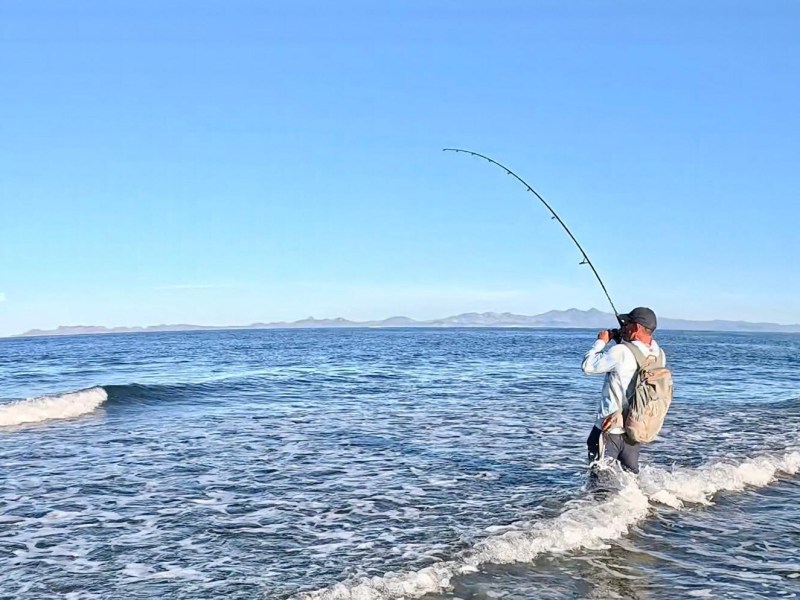
Shore jigging the beaches of the Baja Peninsula is more than just surf fishing. It is a culture built of exploration and adventure, a pursuit that combines the beauty of days and nights spent on unspoiled coastlines with frenetic and transient bursts of fishing activity. It might not be the easiest way to catch fish, but for some it is the most rewarding.
Along a desolate stretch of the Sea of Cortez, I noticed shoals of nervous water coalescing near the reef. A half dozen frigate birds trolled above. A dozen pelicans sat along the beach. If anything was going to happen, it had better hurry up. There was only half an hour of daylight left.
One of the frigates made a spiraling dive toward the sea. He pulled up right above the surface. Another frigate followed. In unison, the pelicans shook off their slumber and flapped toward a disturbance. Just beyond casting distance, something was happening.
Suddenly, showers of baitfish leapfrogged one another in a desperate effort to flee. Large boils appeared in the sea, and a smacking sound broke the quiet. Closer to shore, baitfish scattered and leaped. In a few moments, the whole beachfront erupted into chaos.
Jack crevalle, called toros in Mexico, pushed schools of sardines and ballyhoo into the shallows. A few moments ago, this was all beyond my reach. Now, there were baitfish beaching themselves at my feet. I felt the panicking ballyhoo bumping my shins.
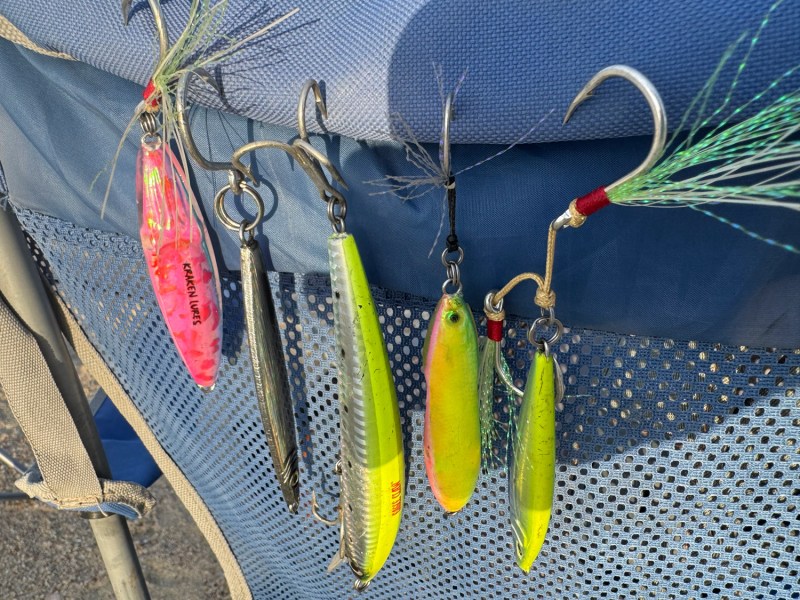
I cast a greenish K-25, a 25-gram neutrally balanced jig, into the blitzing jacks and immediately felt a grab. I missed that fish, but immediately hooked another. Jacks slashed at bait not 5 feet from shore. Pelicans scythed through space at reckless angles. They struck the surface just 10 feet off the beach. Terrified baitfish crashed ashore 20 at a time, and I had a passing thought of scooping them up.
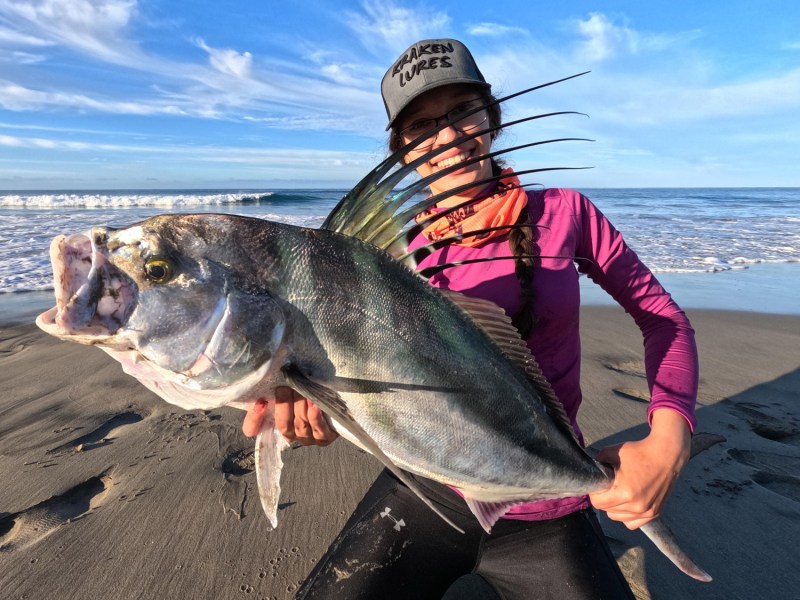
The fish at the end of my line turned out to be a young roosterfish. Lit up, with his tall dorsal fins cutting the surface, the fish glowed blue in the low light. My dog crowded in for a closer look. I released the rooster and cast back into the fray to catch jacks that tested my drag and watched rooster combs cut the schools of bait.
Then, as quickly as it had started, the feeding frenzy fell apart and moved offshore, beyond my reach. The pelicans flew back to their roosts on the beach, and it was over. It was dark enough now to see the distant lights of La Paz, the capital city of Baja California Sur.
Shore Jigging the Baja Peninsula
With my tent set up on the beach, I sank into a canvas chair and tried to catch my breath. I lit a small fire of driftwood and dried cholla. I ate snacks and settled in for the night. The sea went flat calm, and it was hard to fathom how quickly the predators had come and gone.
With so much bait in the area, I hoped to see a frenzy like that once more. Even if the fish didn’t come back the next morning, the sunrise over Espiritu Santo Island would be worth a night in the tent with a wet dog.
The best thing I did when I moved to La Paz, Mexico last winter was walk through the front doors of Kraken Lures. Owner Adan Arce is a shore-jigging aficionado who has spent years testing and tinkering with his custom jigs. The K 25 mentioned earlier grew dear to me as I tested Baja’s coves and rocky points.
I tagged along with Arce on January fishing excursions to the Pacific side of the Baja Peninsula and learned I needed new gear. I had much to learn about the shore jigging and the unique culture of the technique.
Surf Fishing Gear for Shore Jigging
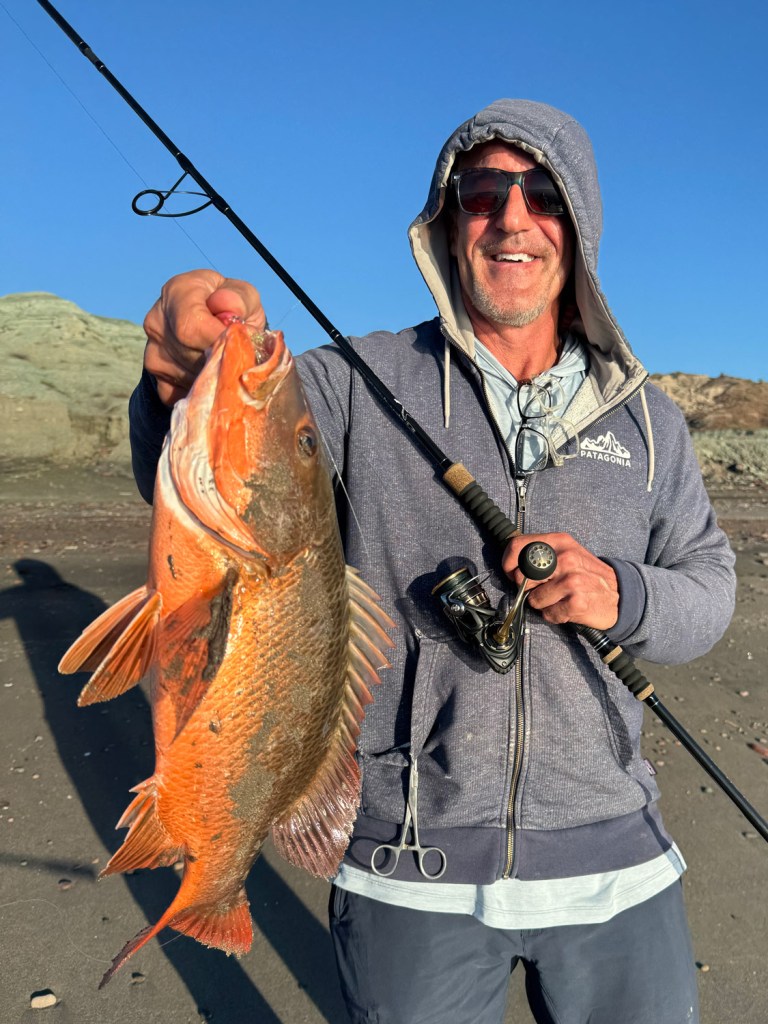
The typical shore-jigging outfit requires a 9-foot surf rod and a medium-sized spinning reel, say a 4000, spooled with 15-pound braid. Light braid allows for the tremendous casts required to reach fish. Attached to the braid is at least 6 feet of 25- to 30-pound fluorocarbon. I learned to tie the Albright knot to fasten braid to fluorocarbon. Some of the target species, especially Sierra mackerel, are leader-shy, hence the expensive fluoro.
With shore-jiggers, the cast is everything. When one witnesses them performing their craft, the word that comes to mind is kinetic. Most shore-jiggers abhor the sedentary act of trolling. I’ve been with them in pangas when they asked the captain to drop them off on rocks and sandy stretches of beach in order to wander and cast at their own leisure.
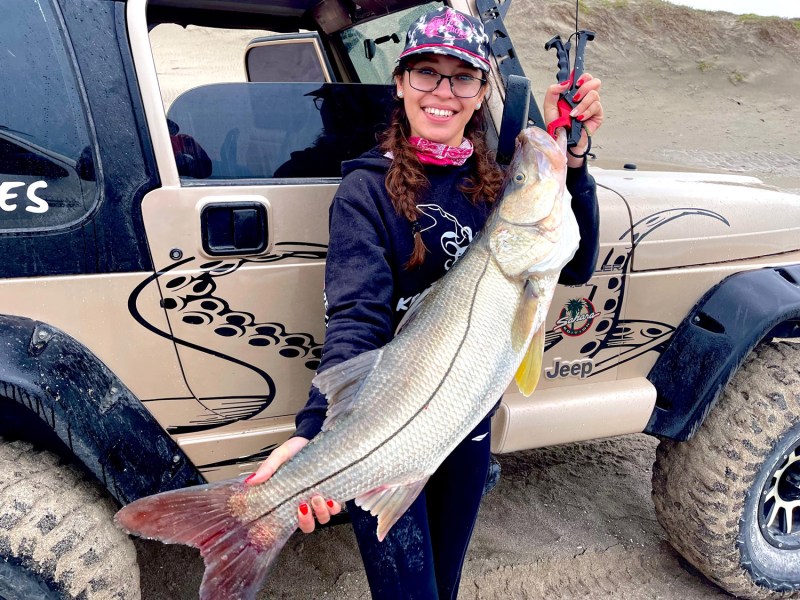
Success from the panga is more likely, but shore-jiggers are after something ineffable. With the jig resting in the sand behind them, they step into each cast in the same way Novak Djokovic delivers a serve at Wimbledon. Of course, many of the species they fish for—corvina, snook, roosterfish—will attack a lure right at your feet. It’s a visual event to see the sleek shapes of corvina chasing sardines in a pane of green waves. The action is in your face. But, just like the best bite, it’s gone as quickly as it appeared.
Magdalena Bay California Halibut Fishing
On a February trip to Magdalena Bay, on the Pacific side near the city San Carlos, I targeted California halibut with Arce and his partner Ailin Polentarutti, a shore-jigger in her own right who sometimes goes by the handle Polenta. We fished while the rest of the pangas sprinted out toward the open Pacific to intercept friendly pods of gray whales that have made the area famous. Though mainly a fishing village, Puerto San Carlos receives an influx of tourists during the whale-watching season, January through March.
Our captain, Marcos Saldana, offers whale watching, kayaking and other adventures. A lifelong local waterman, his passions range from ecotourism to hardcore fishing excursions. He tipped us off to the arrival of halibut in big numbers. He had several points and breaks in mind where we could disembark and cast at will.
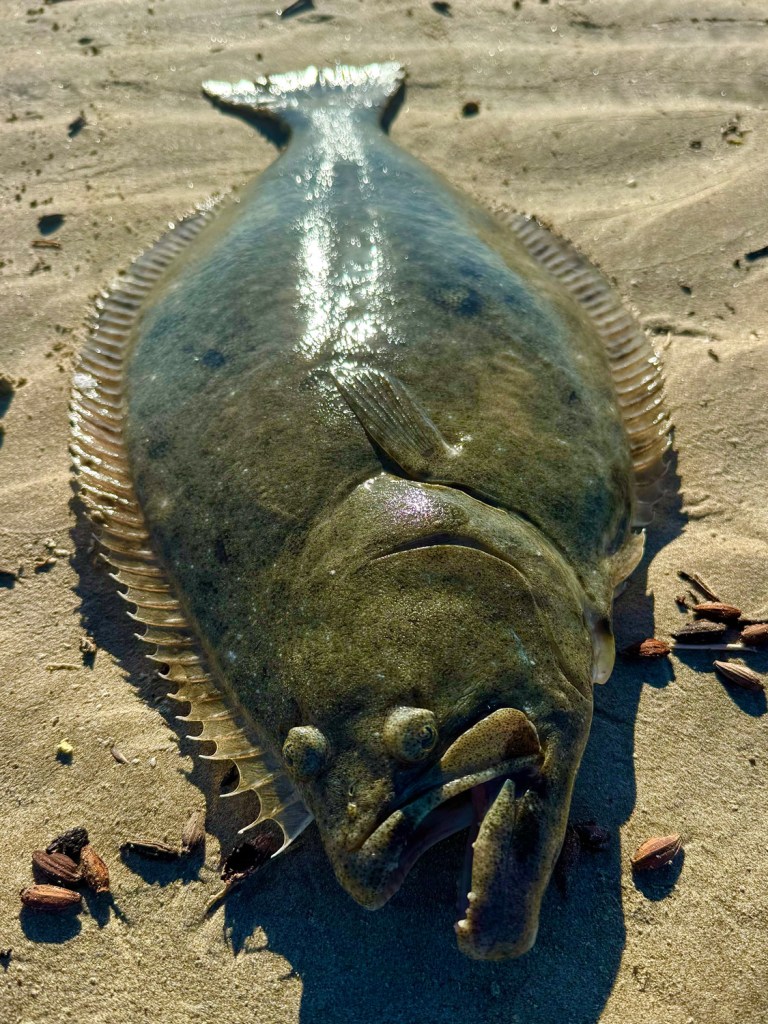
I caught my best halibut on a gradual, sandy drop-off. Lenguado in Spanish, these fish ambush jigs and soft plastics. When many of the warm-water species have departed, California halibut come into Mag Bay to fatten up on shrimp and sea worms. As Capt. Saldana pointed out, once you find one, you’ve found the whole school.
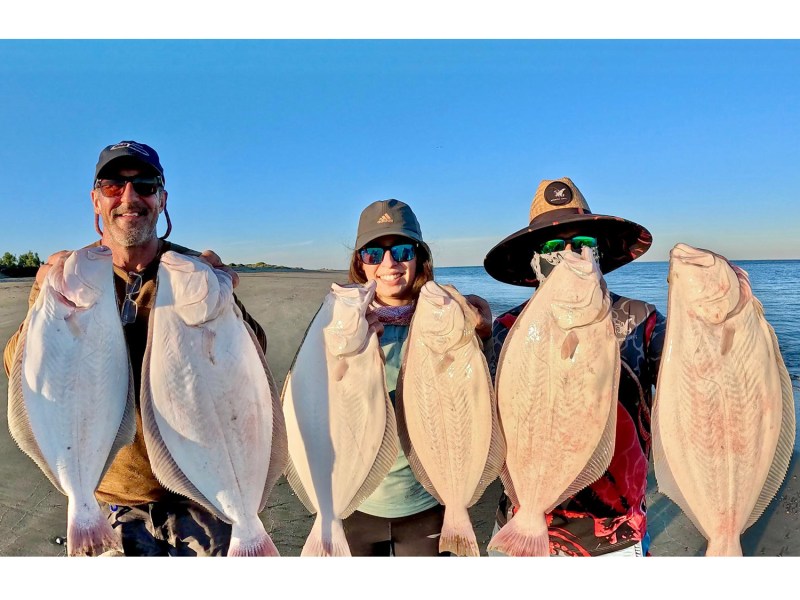
My first halibut was my best, a whopping 25-inch fish that threw mud all over my clothes and sunglasses with its broad tail. Of course, the biggest fish got away. Late in the morning, I hooked a solid fish that came in with little struggle.
As so many wild creatures do, it enlivened only when it realized its life was in danger. At the shoreline, the fish dug its fins into the sand and held firm. Using the wave action, I tried to skid the fish ashore as I had witnessed Polenta and Arce do that day.
Halibut have sturdy frames, but their mouths are delicate. The jig was in the corner of the fish’s mouth, pierced through a paper-thin flap of white cartilage. The fish arched its body, opened its mouth, and shook violently.
I saw, in slow motion, it seemed, the jig fall from the mouth. I did what anyone would do. I leapt on the fish and tried to hug it to my chest and felt it slowly slip away. With its thrumming tail, the fish covered me in saltwater, mud, and an enduring sense of loss. Regrettably, Arce got most of it on his GoPro. We laughed at the clip and played it over and over.
But never mind, we were off to the rocks to cast for red snapper, barracuda and cabrilla. I caught my first white seabass, a juvenile, near the abandoned fish farms. Marco gave us a tour of Magdalena Bay that few others ever get. At each location, we hopped out and dispersed along the shore.
Surf Fishing out of La Paz, Mexico
After that trip, I began tagging along wherever they invited me. Most of our excursions departed La Paz in the wee hours of the morning. At kilometer marker 100 of the Transpeninsular Highway, we stopped at an anonymous and seemingly unpopulated roadside community where we bought empanadas that had no equal. We ate them in the cab of my truck while bumping over arduous sandy roads that led, eventually, to the sea.
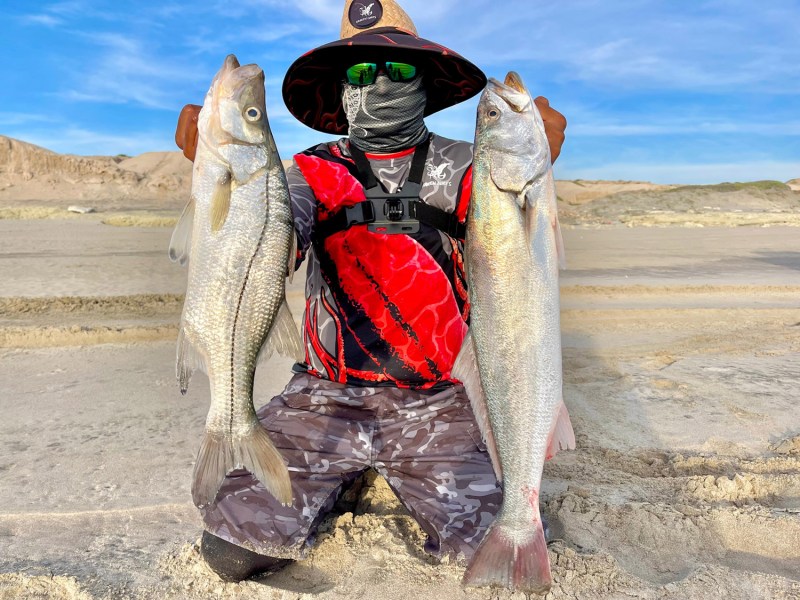
Polenta and Arce knew about tides. They fished with vigor for periods of time, then called it quits and sat in the shade. With wide-brimmed straw hats and long-sleeved shirts, they didn’t risk sun exposure.
They tolerated my black Lab, Henry, rushing in to nip at their corvina. If they didn’t get a strike after a handful of casts, they were quick to change jigs. They experimented with jigs that swam differently, had different colors, and sank at different rates. They sped up their retrieves and skipped jigs across the water. They let them sink to the sandy bottom and retrieved them slowly.
I was learning Spanish painfully slowly. Most of my words were about fish, whales, fishing equipment and food, mainly empanadas. My best fish of the season, a Pacific red snapper, came by casting into the sunrise at a cove that is hardly visible on any map. When I asked Arce how he picked the place, he shrugged. He had never been there before. He just had a feeling.
“Aventura,” he said as he tucked the snapper into a cooler and covered it with ice.
Adventures on the Sea of Cortez
After a few weekends out with Arce and an equipment update, I felt confident enough to lower my tire pressure, put the truck in four-wheel drive, and look for my own secret spots. I learned where to camp, where to gather driftwood (cholla, in my opinion, burns the sweetest), and how to spot nervous water in the surf.
I saw dead sea turtles on the beach, whale bones bleached white and breaching in the sand. The seashells were so perfect and numerous that I dedicated myself to leaving them where they lay.
I picked a place on the map and went there with my dog. Often, we were the only ones on the beach. There were long periods of doldrums when I couldn’t buy a strike. Then, because the tide changed, or the time of day, or for no particular reason at all, the fish showed up, and my drag sang.
If I learned anything about shore jigging from Arce and Polenta, it’s that being there at the right time is the most important part of fishing. Take chances. Change things up. Aventura.