

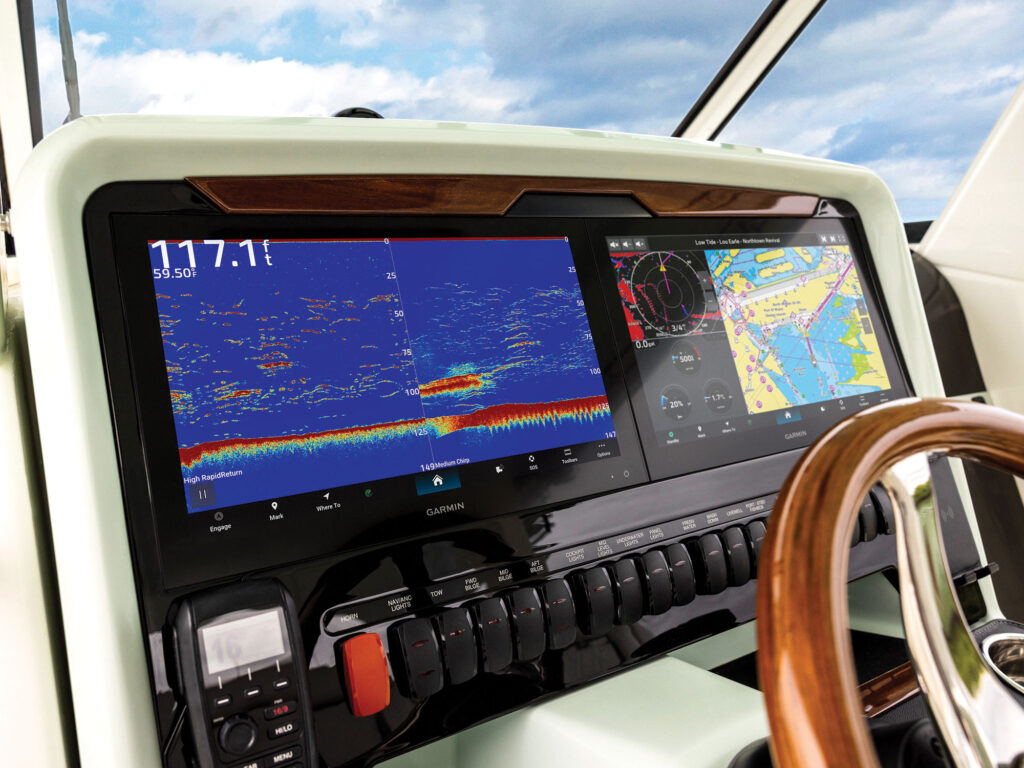
Today’s saltwater anglers rely heavily on sonar to locate fish, but a fish finder is only as good as the transducer it uses. When deciding on a sonar system, you need to put serious thought into what type of transducer will suit your needs best. One of the most common decisions revolves around transom-mount versus thru-hull transducer styles.
To help boat buyers decide, we asked Craig Cushman, director of marketing for Airmar Technology Corp., to explain the upsides and downsides of each transducer style. Airmar builds many of the transducers offered by major electronics brands, including Furuno, Garmin, Lowrance, Simrad and Raymarine.
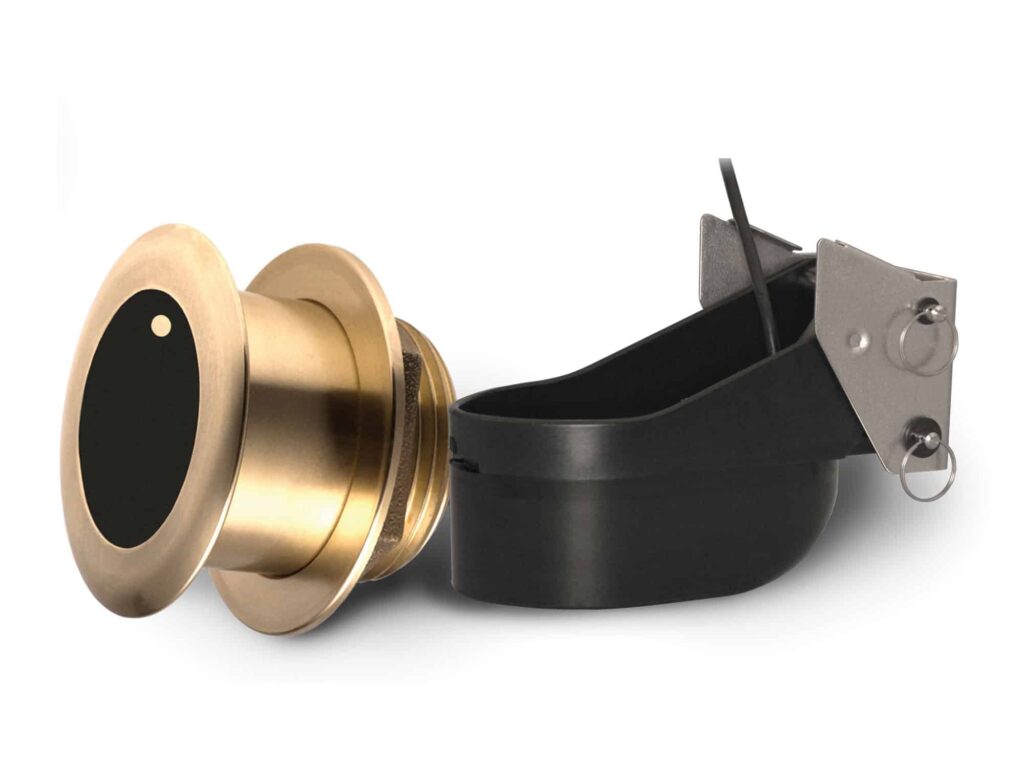
Cushman focused on comparing two of Airmar’s most popular and advanced transducer families—the TM185 transom-mount series and the B175 tilted-element low-profile thru-hull series. Both are available with 1kW chirp-ready high-, medium- and low-frequency transducer elements in a range of beam angles.
Boat Size Matters
Before getting to the pluses and minuses, Cushman offers an important caveat: Both of these transducer styles work well on outboard-powered conventional hulls under 36 feet in length overall, he says. Boats longer than 36 feet, however, tend to create a thicker “boundary layer”—highly aerated water between the hull and sea surface—than smaller boats. Air in the boundary layer interferes with the transducer’s echo-sounding signals and returns.
“Both the TM185 and the B175 series are relatively low profile in nature, and that works well on smaller boats with comparatively thin boundary layers,” Cushman says. “Larger boats need a thru-hull transducer that protrudes farther down into the water, beyond their inherent boundary layers.” Cushman says the Airmar B265 stem-style thru-hull with an optional fairing block is a popular choice for bigger boats.
Read Next: Pair the Right Transducer to Your Fish Finder
Transom-Mount Benefits
Ease of installation represents the biggest upside of a transom-mount transducer such as the TM185. Unlike the B175, there is no need to cut a hole in the bottom of the hull, an anathema to some boaters. The TM185 does require drilling four 5mm holes, each 22mm deep into the transom near the bottom of the hull, for the mounting screws. Installing the TM185 is easy to do on your own. Should you make a mistake, patching a 5mm hole is much easier than repairing the 3.75-inch hole needed for the B175.
Transom-mount transducers are less expensive than comparable thru-hull models. For example, Hodges Marine retails the Airmar TM185HW (high-frequency chirp, wide beam) transom-mount transducer for a Furuno echo sounder for about $922. On the other hand, Hodges’ price for the comparable B175HW for a Furuno starts at around $1,251.
Adjustability is another advantage of a transom-mount transducer. You can easily move the ’ducer up or down to fine tune the height with the bracket of the TM185. You can also adjust it horizontally, tilting the aft end of the transducer ever so slightly to better penetrate the boundary layer.
“Transom-mount models also prove easier to replace should one become damaged or you decide to change to another chirp-band,” Cushman says. “If trading for another TM185 model, you can use the same bracket and just route the new cable.”
Finally, if you trailer your fishing boat, transom-mount transducers are less likely to interfere with bunks or cross-members when launching and loading.
Thru-Hull Advantages
“The greatest advantage of the B175 tilted-element series lies in how deep these transducers sit in the water,” Cushman says. “Depending on the boat hull, they can be mounted very close to, if not on, the centerline on boats that have a wide keel pad back by the transom.”
On my single-outboard 22-foot deep-V center console, for instance, the B175 transducers (I have two—one High Wide and one Low, both 20-degree tilted elements—on each side of the keel) sit 5 inches deeper on the hull than the transom-mount model. In addition, the B175s are 4 inches from the centerline, while the transom-mount model sits 10 inches from the centerline. Because B175 transducers extend only ¼-inch or so below the bottom of the hull, they result in minimal disruption of water being fed to outboard propellers while underway.
Unlike transom-mount models, the B175 series can perform effectively on step-hulls, but need to be installed forward of the steps to avoid interference from the aeration streaming under the hull aft of the steps while underway, Cushman points out.
Transom-Mount Caveats
Susceptibility to aeration ranks as the main disadvantage of a transom-mount transducer, says Cushman. This can impair fish finder performance while the boat is underway, but is not an issue at idle speed or when drifting. Excessive aeration is often the result of improper installation or poor adjustment, but with the right adjustments, it can be corrected or at least minimized.
Thru-Hull Downsides
Overcoming the angst of cutting a 3.75-inch hole may be the biggest downside of the B175 series, but with cored hulls, installation gets even more complicated. In this situation, Cushman recommends turning to a qualified shop to handle the work. Cored hulls or not, installation costs for a thru-hull unit are going to be higher than for a transom-mount.
Finally, it is not nearly as easy—or inexpensive—to replace or upgrade a B175 transducer as it is with a TM185. “This is partly because removing one of the big thru-hull transducers can be quite an undertaking,” Cushman explains. “Then comes the installation of the new transducer.”
Retrofitting a boat with a new thru-hull transducer may be another job best left to a qualified installer, as removing the previous transducer needs to be handled carefully in order to avoid damage to the bottom of the hull.
Ultimately, the answer to the common question from many boating anglers—thru-hull or transom-mount?—boils down to the type of boat and the boat owner’s mindset. Both factors can change as anglers buy new boats or consider new transducer technologies. I was a transom-mount man for many years, but as tilted-element technology advanced, I switched over to the thru-hulls and found to my delight that they perform best on my boat.
Single-or Multi-Channel
There’s no dual-channel model in Airmar’s B175 series. This contrasts with the transom-mount TM265 and TM275 series, which offer two channels and are the same length and width as the TM185, but a half-inch deeper. They are more expensive than the TM185, retailing for as much as 74 percent more for the TM265 and TM275, respectively. “That’s still less expensive than with the B175 low-profile titled element series,” Cushman says, “because you will need to buy a second B175 transducer to achieve two-channel capability.”