The Beyond Our Shores Foundation Dolphinfish Research Program recently released updated findings from an extensive study on the species. Instituted in 2002, the program was federally funded until it began operating as a non-profit organization in 2018.
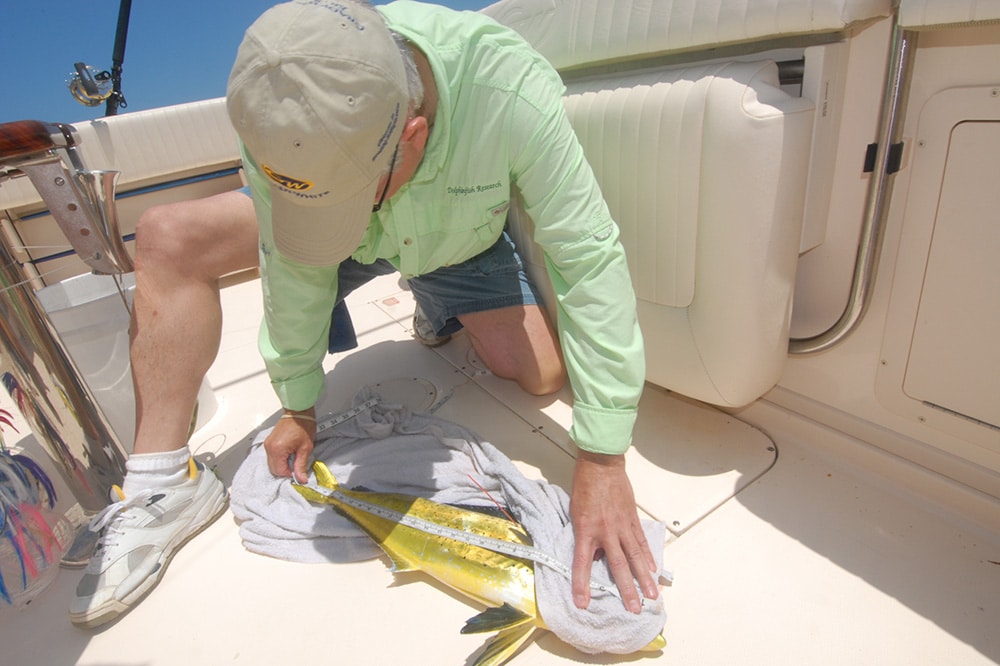
Below are some facts previously known about dolphin, along with new information regarding migration patterns, travel speed, and more from the tagging program. In working with anglers through the research program, more than 39,500 dolphin were tagged by nearly 6,200 anglers. A total of 902 tagged dolphin recoveries have been reported. Just over two-thirds of the fish marked and released in the 25-year-old study were tagged off the east coast of Florida.
General Facts About Dolphin (Mahi)
- They grow, on average, as much as .98 inches per week.
- Dolphin can eat up to 20 percent of their body weight in a day.
- They can grow to weights of 25 pounds within the first 12 months of life.
- This species generally reaches sexual maturity at three to five months of age.
- Few dolphin live longer than two years.
- The oldest documented dolphin was 4 years old.
- Dolphin do not have eyelids and are not known to sleep.
- Lacking an air bladder, they will sink if they stop swimming.
- Spawning likely occurs every month of the year in the western North Atlantic Ocean.
- More dolphin are caught by recreational anglers in the Gulf of Mexico and South Atlantic Bight than all of the yellowfin tuna, blackfin tuna, wahoo and king mackerel combined in those regions.
Facts Learned from the Dolphinfish Research Program
- These fish can travel as far as 152 miles in a straight line during a 24-hour period as shown by a satellite tag track.
- Dolphin were observed to dive to depths greater than 800 feet deep. It is most likely a behavior associated with feeding.
- Dolphin engage in deep diving more at night than during the day.
- Deep diving appears to be associated with feeding on animals that live in the great depths of the ocean during the day that migrate up the water column at night.
- There are regional differences in depth use between the US East Coast, the Caribbean Sea and Eastern Tropical Pacific Ocean.
- One satellite track showed that a fish released off Charleston, South Carolina, had circumnavigated the Sargasso Sea winding up at the Mona Passage between Puerto Rico and the Dominican Republic six months and around 8,100 miles later, suggesting a migration route that circumnavigates the Sargasso Sea.
- Dolphin were shown to spend as much as six weeks in large semi-permanent gyres that occur in the North Atlantic.
- Dolphin migrate predominately to the north along the US East Coast.
- Dolphin appear to travel in a clockwise migration in the western central North Atlantic throughout the year.
- Fish released off eastern Florida have been recovered off all US Atlantic coast states expect New Hampshire and Maine.
- Fish released off the US East Coast have been recovered off the Azores, Cuba, Dominican Republic, Puerto Rico, Virgin Islands, Anguila, St. Barthelemy, St. Kitts, Antigua, St. Vincent and the Grenadines, Venezuela, and Mexico.
- Two crews of vessels have tagged more than 9,000 dolphin.
- Fish tagged off the US East Coast and recovered in the Caribbean Sea or western North Atlantic tropical waters were at liberty for an average of 254 days.
- Fish tagged in the Gulf of America have been recovered in the Florida Keys and western North Atlantic off the western Bahamas.
- The average travel speed of fish tagged off the East Coast of Florida varies annually, ranging from 10.4 miles per day to 44.9 miles per day, with an annual average of 24.8.
- Migration speeds vary by region. Dolphin move slower off the Carolinas than off eastern Florida.
- Dolphin are capable of sustained high-speed travels. An example is a fish that went from the Florida Keys to Oregon Inlet in nine days, covering 893 miles.
- Twenty-nine fish traveled from Florida to off Maryland to Rhode Island on average in less than two months.
- Fish tagged and later recaptured in the Caribbean Sea and off the north coast of the northern Caribbean Islands always moved in a general western direction.
- Dolphin released north of the Greater Antilles were found to have the slowest average rate of travel, 3.0 miles per day in their migration, while fish in the Caribbean Sea traveled at an average rate of 12.4 miles per day.
- More than 45 fish have been recovered more than 1,000 miles from where they were released.

- The longest distance traveled by a tagged fish from its release site belongs to a fish released off Charleston, South Carolina, that traveled 2,500 miles in a straight line into the eastern North Atlantic.
- Dolphin have been found to linger in the Bahamas in the Tongue of the Ocean for 77 days, in Exuma Sound for 14 days, and in the North East Providence Channel for 22 days.
- Dolphin have been found to linger off South Carolina for 76 days, and off Cape Hatteras/Oregon Inlet for 28 days
- Small fish tagged off the U.S. East Coast returned the next year as large adult fish, shown by 51 such recoveries.
- The larger the fish was when tagged, the better the chance that it was recovered.
- Of the fish tagged off eastern Florida, 346 or 38% of the program’s recoveries occurred off the state from 0 to 58 days later.
- Recoveries of fish tagged south of Florida and in the Keys and recovered in the same area three months or more later, coupled with the recapture of South Florida fish off the eastern islands of the Bahamas, suggest an alternate, mini-migration route around the Bahamas Bank.
- A small percentage of the fish tagged in the area of Cape Canaveral, Florida, down to Miami that were later recaptured, exhibited a southern inshore movement traveling as far south as Key West.
- Southerly movements varied seasonally with more records observed during the Fall and Winter.
- Dolphinfish can spend as much as two months riding the circular motion of ocean gyres.
- Dolphin have been recaptured in the Mid-Atlantic Bight showing movements north and south along the bank between offshore canyons, and moving inshore and offshore from shelf waters.
- Dolphin have been tagged and released off North Carolina and Rhode Island and recaptured along the US East Coast south of the release locations in the year subsequent to being tagged.