
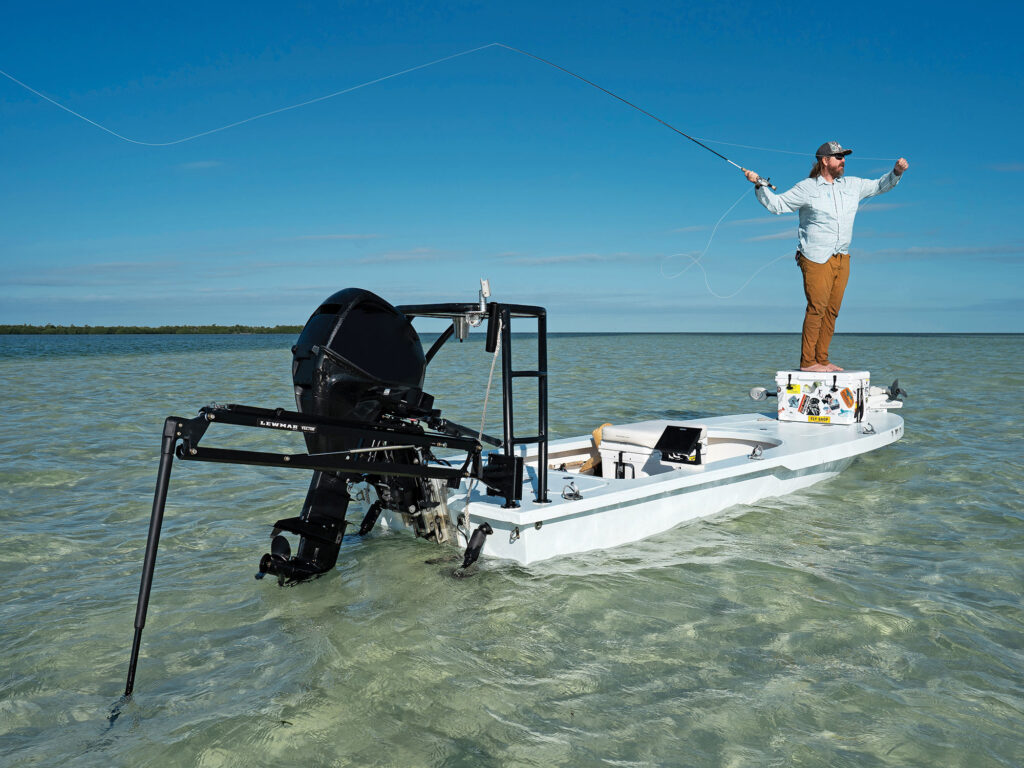
It has been 25 years since Power-Pole revolutionized shallow-water anchoring. In that time, systems have advanced and new players have entered the market, but the original innovative idea — an automated stake-out pole or two mounted on or around the transom— was good enough to change the way anglers position their boats.
“I was fishing the flats of Sarasota Bay using an anchor, chain and rope, trying to stop before I got too close and spooked the fish,” said John Oliverio, CEO of JL Marine Systems, the company that makes Power-Pole. “I thought, ‘If I could just hold right here, I could catch all those snook.’ That’s when I came up with the idea for the Power-Pole.”
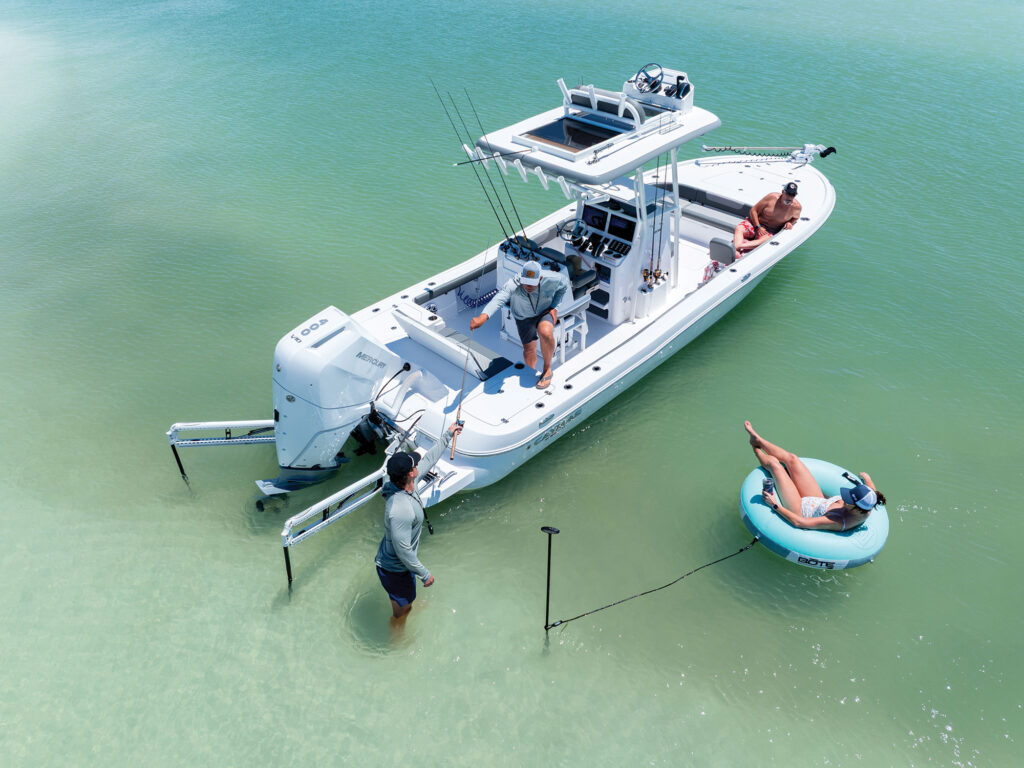
Power-Pole originated shallow-water anchoring systems that today use different mechanisms to deploy stakes into the bottom and hold a boat in place. They are less obtrusive than tossing a regular anchor or virtual anchoring with a trolling motor. They deploy in seconds to stop the boat on a dime, and retract just as quickly. And they are easy to operate with the push of a button.
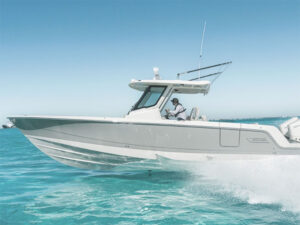
Many boat builders and dealers offer these systems on new boats—particularly on bay boats, hybirds, and flats skiffs. There are a number of available choices in brands, lengths and configurations. Here’s what you need to know to make a decision that’s right for your boat and style of fishing.
Hydraulic Systems
Hydraulics powered the original shallow-water anchors, and hydraulic systems remain the preference for many saltwater anglers. They are generally considered more powerful and durable than electro-mechanical systems for rougher conditions and a variety of bottom compositions. The downsides are the hydraulic pumps, which add weight and take up valuable storage space. Installation can also be more complicated with the necessary hoses and wiring.
Power-Pole offers five models with varied price points for everything from kayaks to bay boats in water as deep as 10 feet. Except for the electric Micro Anchor, all of Power-Pole’s systems use hydraulics to extend lightweight aircraft aluminum arms down and away from the transom before driving a fiberglass spike into the bottom.
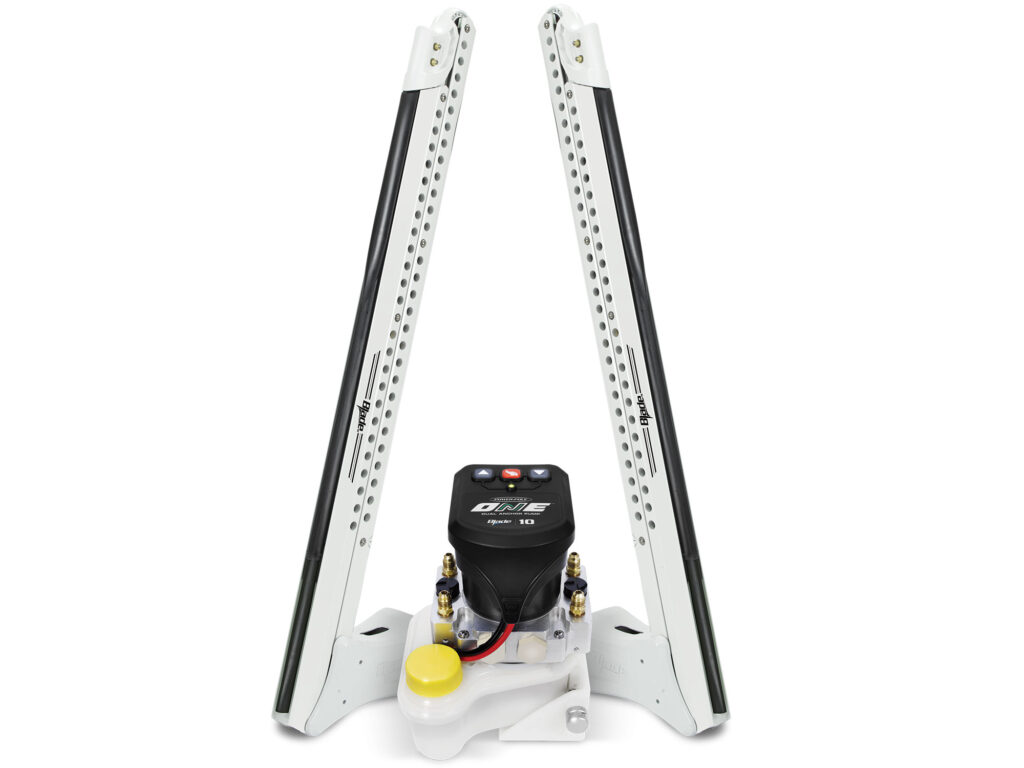
For years, Power-Pole’s flagship system has been the Blade. The company’s latest innovation is the One Pump system, which allows control of dual 8- or 10-foot Blade anchors with a single hydraulic pump. The One Pump system takes up half the space of individual pumps for each blade, it’s 10.8 pounds lighter, 41 percent more energy efficient, and it’s also said to be smoother and quieter. The Blade Dual Anchor, One Pump system retails from $4,399.99.
Today, Minn Kota is another major player in this market. Its first foray into shallow-water anchors was the Talon, an electro-mechanical system that still offers advantages (more on that later). The company jumped into hydraulics in 2020 with the Raptor system, a hydraulic arm with a spike. The Raptor features smart technology called Active Anchoring and Auto-Bottom Mode that is said to continually analyze changing water and bottom conditions to stay firmly anchored. When stowed, the Raptor’s pump holds it tightly, eliminating the need for special covers or bungies for running or trailering. The Raptor is available in 8- and 10-foot lengths, from $1,699.99 to $2,099.99 for single units.
Electric Systems
While electric-powered shallow-water anchors were initially thought to be too delicate for marine use, decades of advancements have produced systems that are saltwater ready and offer advantages to fishermen on backwaters and flats.
Minn-Kota’s Talon system was redesigned in 2017 and has proven to perform well. It uses a self-contained electro-mechanical system to drive a composite spike vertically into the bottom. In tight backwaters or marinas, this vertical deployment requires less space than extending arms. This is also advantageous if a feisty tarpon or a high-speed bonefish decides to race across the stern.
Need more depth? The Talon is available in a 15-foot model as well as 8-, 10- and 12-footers for anglers who want to pin down in the channel. A cool feature of the Talon is three anchoring modes for different bottom compositions. A rough water mode automatically drives the spike every 10 seconds to account for wave action. The Talon costs $2,199 to $2,699 — for a single unit depending on the length.
Looking for a lightweight electric system that’s easier on the bank account? Check out Lewmar’s Axis. Lewmar promotes simplicity of installation and maintenance for its 12-volt electric-powered aluminum arm and fiberglass spike that deploys quickly with a push of a button. Two anchors can be deployed from one remote, and the powder-coated aluminum is corrosion resistant.
With 6- and 8-foot lengths suitable for vessels up to 26 feet, these units are a good choice when weight is an important consideration. The 6-foot model is just 15 pounds, and the 8-footer weighs 26 pounds, so they won’t bog down your lightweight technical flats skiff. Axis anchors retail for about $1,000 each, depending on the distributor.

Connectivity
While the Lewmar system is a simple push-button remote, both Power-Pole and Minn-Kota invested in connectivity that allows control in a variety of ways.
You can raise and lower a Power-Pole with a wireless remote, foot switch or dash switch, and the company’s C-Monster network—standard on all Power-Pole products—is compatible with a smartphone app and multifunction displays from brands like Lowrance, Garmin, Mercury and Simrad. In addition to allowing wireless, customizable control, it offers diagnostics services, software updates and more.
Minn-Kota systems use Bluetooth to operate with a wireless remote, foot switch, smartphone app, i-Pilot or the control panel on the anchor. They also pair with Humminbird MFDs.
Simplicity
For the Luddites, Lewmar’s Vector is a good choice. It is designed for fishermen who want solid performance at a good price and don’t mind manual deployment of a shallow-water anchor. The Vector uses a gas spring for easy pull-rope operation of an aluminum arm with a fiberglass spike. It’s available in 6- and 8-foot models for boats up to 22 feet and costs about $500, depending on the retailer.
Single vs. Twins
It’s rare today to see anything other than twin shallow-water anchoring systems on a bay boat or hybrid. Just one anchor will keep your boat in place, but also allows it to spin with the current and wind. Two poles lock the boat in the position and the best orientation (for example, with the bow aimed at the mangrove shoreline) for pinpoint presentations to cover and fish. The downside, of course, is twice the cost, but serious shallow-water anglers in pursuit of redfish, snook and tarpon would not have it any other way.
Mounting Options
Shallow-water anchors can be securely bolted to the transom of the boat, but there are accessories from the major brands that integrate the outboard engine bracket and/or jackplate to eliminate the need for extra holes in the transom. For example, Minn Kota’s Raptor one-piece aluminum jackplate adapter bracket ($379.99) bolts to the side of the engine jackplate. Available in a variety of setbacks and heights, it offers plenty of clearance for the outboard to turn without interference. If you don’t have a jackplate, you can add the Minn-Kota universal sandwich adapter ($149.99) between the engine bracket and transom to create a mounting point for a jackplate adapter bracket.