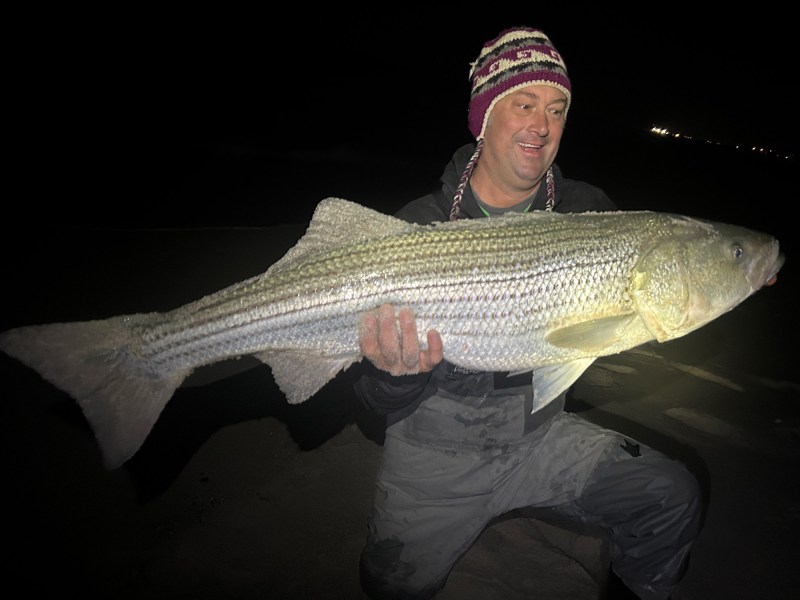
Striped bass feed aggressively in the surf at night, and fall is the time to catch them on the New Jersey coast. Fishing at night for stripers in the surf requires know-how and research beyond just showing up and casting into striper blitzes like anglers do in the daytime, but spending some time on the beach at night can acclimate anglers quickly.
Bundle up and head to the beach this evening. You’ll avoid the crowds and catch some fish.
How to Identify Structure for Stripers
Jersey doesn’t have the rock structure of Cape Cod or Montauk, but there is still structure in the form of subtle cuts, sloughs, rips and sandbars — all of which aggregate bait and striped bass.
Nighttime fishing requires some daytime reconnaissance. When the sun is up, pick a beach you like to fish and study where the cuts, sloughs and sandbars evince themselves at all stages of the tide. This way, when it gets too dark to see, you’ll know how to maximize your time at night to hit areas that will be most productive.
Watch during the day to see where the bunker, sand eel, spearing and bay anchovy schools situate. They will probably be in the same area later. Most times, bass congregate and move in during times of higher water, meaning the two hours up to the high tide and the first two hours of the outgoing tide. Striped bass feed on bait schools pushed into the sloughs when there is enough water for them to enter and feed.
Use All Your Senses to Find Striped Bass
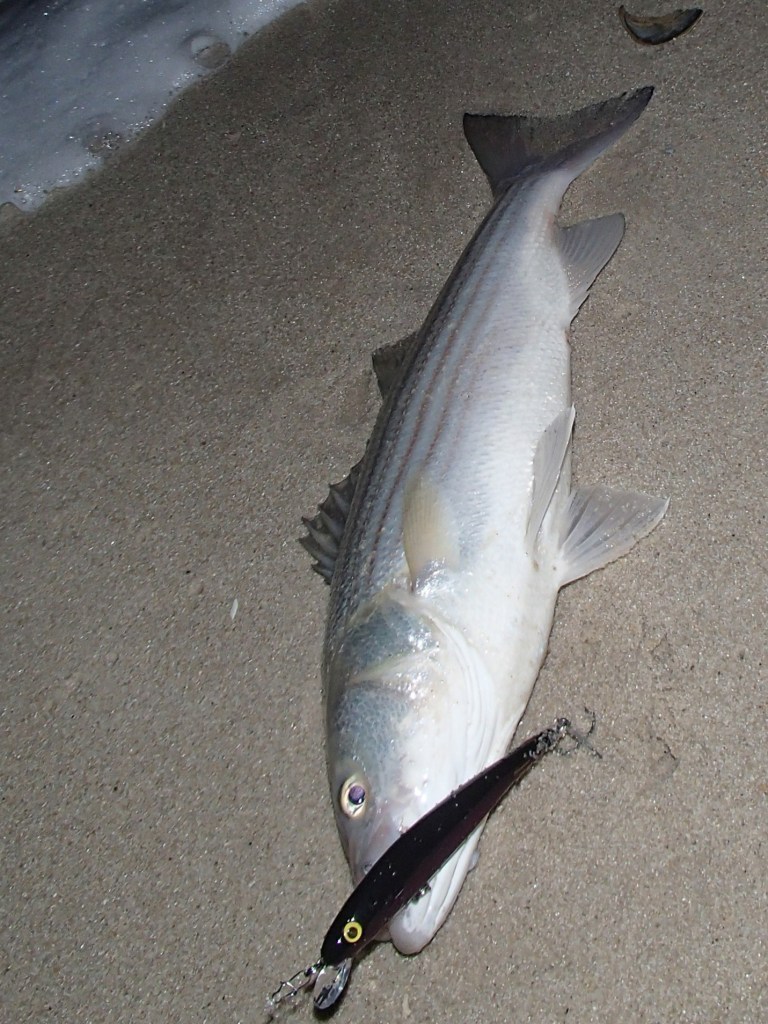
A key to nighttime surf fishing for stripers is to utilize senses other than eyesight. Surely you will still be able to discern a sandbar with breaking whitewater, even at night, but more importantly, keep your ears open for fish crashing on bait schools. It is mostly a silent arena, and you can hear striped bass feeding at night. Also, note the smell in the air. If you catch the scent of baitfish in the area, chances are stripers will be there as well.
How to Fish for Stripers at Night
Casting plugs at night is done by feel. Stay in constant contact with your lure, feeling how it swims to maintain a legitimate presentation. Too much slack in the line, and the lure gets pushed in. Too much tension, and the lure swims too fast.
Slow and steady is key when working plugs. Generally, reeling once every second or two gives a slow wobble to a plug. Though striped bass will inhale a plug, many times they will test tap it and you will feel the semi-strike. Don’t give up if you miss a shot. Keep the slow cadence going, and the bass will nearly always come back to hit it again.
If you do miss a strike, remember how far out the lure was, and cast to the exact spot again. Fish often remain in that immediate vicinity for 30 seconds or so before moving on. However, if you miss a fish and don’t get it on the next two or three casts, let the water settle for a half hour. Then go right back to that spot, as that striper will likely be there waiting once it forgets it got hooked previously.
Best Tackle for Stripers in the Surf
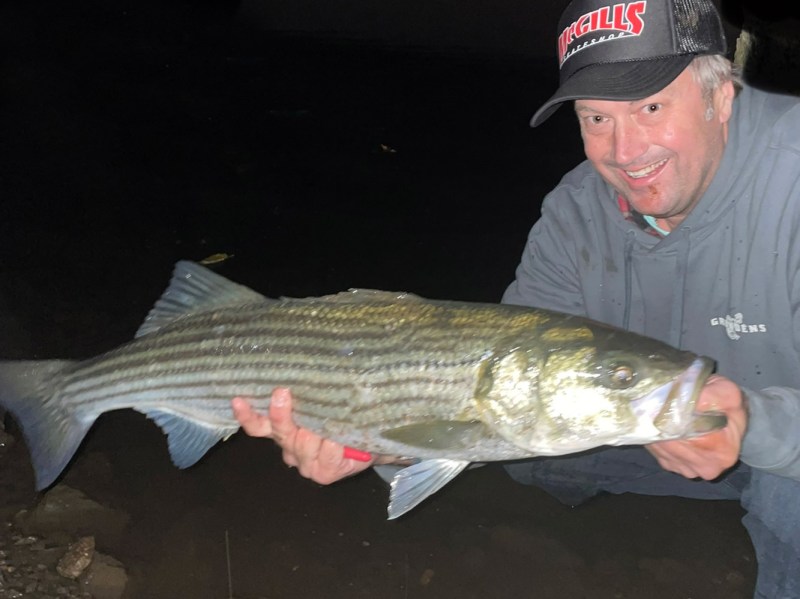
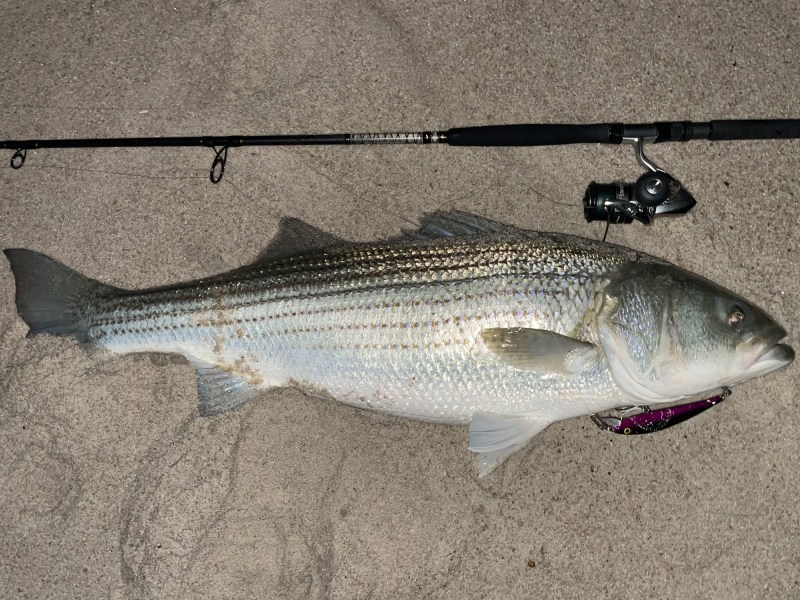
If larger fish are around, meaning anything from 34 to 50 inches, I employ a 9-foot Savage Gear rod matched with a Shimano 5000 Stradic reel, spooled with green 30-pound-test Power Pro Braid. I use a uni-to-uni knot to tie on a top shot of 40-pound Yo-Zuri fluorocarbon or Seaguar fluorocarbon to which a 50- to 75-pound VMC Duolock Clip or Tactical Angler Power Clip is attached with a palomar knot. This setup will also catch smaller fish, but I scale down to a St. Croix Mojo 7-foot, 6-inch rod with the same reel if fish 34 inches and under are the predominant class of fish.
Best Lures for Night Fishing for Stripers
Dark color patterns work magic when fishing for stripers at night. My go-to lure is the old-school black or blurple Saltwater Grade Bomber Long A plug. I’ve nailed down more surf stripers with the Bomber than any other lure.
Other top offerings include any needlefish patterns, Daiwa SP Minnows, metal-lipped wooden swimmers and in some cases, when you need to go a bit deeper, 1-ounce bucktails tipped with a soft plastic.
When smaller fish are around, especially when smaller baits like sand eels, spearing or bay anchovies are prevalent, I throw on a bucktail teaser about 18 inches above the lure, as many times bass will key in on the smaller bait profile. But if big bass are around, forgo the teaser, as it becomes a weak point that will break when they roll on the surface to dislodge the hook.
Timing the Striped Bass Night Bite
In 35 years of keeping logbooks, I can tell you that once the evening sessions run down, people start leaving the beach to pack it in for the morning session. That’s a bad move. An hour or two after total nightfall, the fish adjust their eyesight and begin to feed hard again.
That said, this time of year, most of my nighttime surf sessions last from 7 p.m. to midnight, with a marked hiatus on feeding between 1 a.m. and 3 a.m. It seems to pick up again after 3 a.m., as sunrise usually pops around 6:30 a.m.
Full-moon and new-moon tides tend to bring in more fish. Three days before and three days after a full or new moon seems to be the most productive time, but that’s not to say they won’t hit on the dead moon as well.
The whole idea of fishing the night shift for surf stripers is a more intuitive and instinctual approach. Feel the lure’s movement, understand the structure arena you are fishing and pound it hard with confidence that the fish will move into the area where you are waiting.
Of course, spots in Montauk, the Cape, Nantucket and other arenas have different modus operandi, with boulder fields and rocky coves which require different tactics. For New Jersey, November and December are prime months to hit the suds during the dark hours. Right now, it looks like Jersey will have a late run, as water temps are still high for this time of year.
The night bite should run well through the end of the month, and possibly even into January. Button up, it’ll be cold targeting striped bass in the surf at night, but it will be well worth the effort.