fish finder sounder
A fish finder is a little like a stereo; the matching transducer is like a set of speakers. Buy a better, more powerful stereo and speakers, and you usually can drive louder, crisper audio.
The same relationship generally guides the purchase of a fish finder. Buy a 1,000-watt fish finder and a 1,000-watt transducer, and you’ll achieve greater depth range with cleaner returns compared with a 600-watt system. But that’s where the simple comparison ends.
** Down Low**
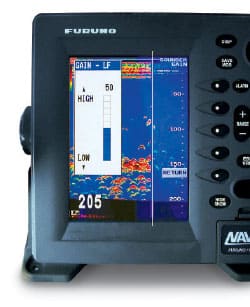
| |The split screen shows a 1 kW transducer return.|
“A 600-watt transducer is traditionally operating with a 50 or 200 kHz signal,” [or 83 kHz in the case of Humminbird], says Sean Edmunds, Southeast regional sales manager for Navico (Lowrance and Simrad products). “When you go to the high-power systems, you can usually change frequency; 1 to 3 kW systems go as low as 28 kHz up to 200.
“Most coastal guys can stay with a 600-watt or 1 kW unit. Who would need 1 to 3 kW? You’d need that if you’re looking for deeper depths past 2,000 feet.”
Raymarine’s Brian Vlad places that depth limit slightly higher — 1,500 feet for the max depth with most 600-watt machines. “But that’s a very general rule of thumb,” he says. “There are many factors that affect that.”
In fact, Furuno’s guidelines suggest a 1,200-foot max depth. All are merely guidelines that suggest an upper limit for simply marking bottom. Any system’s fish-marking depth also greatly varies, depending on conditions.
“The biggest questions consumers need to answer are: ‘What are the depths I’m fishing, and what’s the maximum depth I want to read?’ ” Edmunds says.
Modern 600-watt sounders use a range of power from 100 to 600 watts, but because they usually function well on automatic, the user doesn’t necessarily see the unit change power, Vlad says. “They’ll usually use 100 to 200 watts until they get to 600 to 800 feet of water.”
** Better Listening**
If an angler decides he wants increased depth range and improved fish-finding capability, he could purchase a 1 kW sounder with transducer to replace a 600-watt system, or he might try buying just a more powerful transducer. A 600-watt machine paired with a 1 kW transducer does improve performance.
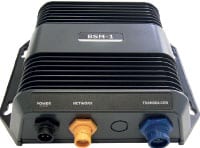
| |Simrad BSM-1 600-watt return|
A higher-power transducer requires either larger elements or more elements in parallel for a greater overall surface area. A 1 kW transducer also is more sensitive, so it “listens” better, Vlad says.
However, the 1 kW transducer also shoots a narrower beam (about 20 degrees) than a 600-watt transducer (about 40 degrees). “That means more definition at deeper depths,” says Adam Kiburz, a Garmin product manager.
Anglers who fish mostly shallow waters might find that narrower beam a disadvantage. A wider beam allows targets to remain in the cone longer.
“On the East Coast, a lot of guys are only looking at the top 200 feet of the water column for game fish. But they want to see what the bottom is doing down to 3,000 or 4,000 feet,” says Steve Bradburn, assistant product manager for Furuno. “They’ll use two transducers — a 3 kW transducer and a 28 kHz frequency to look deep and a 1 kW/28 for shallower stuff. That gives them about a 30-degree look under the boat.”
One caveat about mixing power levels for transducers and sounders: Using a higher-power sounder with a lower-power transducer can damage the transducer. However, many of today’s sounders can detect or recognize the transducer and will self-regulate power.
** Beyond Power**
Sounder-power issues change when the topic turns to Broadband and CHIRP units.
Lowrance/Simrad’s BSM-1 Broadband module generally uses about 200 watts of power and has recorded depths to 5,000 feet, Edmunds says. “It changed the way a traditional sonar works. Instead of focusing power into the water, it’s filtering and looking at the smallest signal returns.”
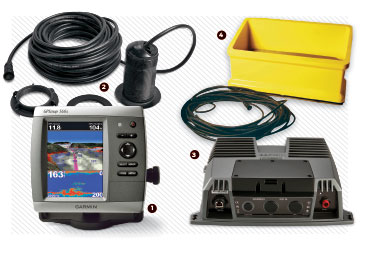
| |(1) Garmin’s GPSMAP 546s multifunction display pairs with (2) a 600-watt transducer. Garmin’s GSD 26 CHIRP sounder module (3) pairs with a transducer (4) that generally measures more than a foot long. Above right: Simrad BSM-1 broadband sounder module (transducer not shown.)|
In order of price and performance, Edmunds says, a sounder lineup would go something like this: 600-watt, 1 kW, BSM-1, 2 kW, 3 kW, CHIRP.
Garmin, Lowrance/Simrad and Raymarine all market recreational CHIRP sounders. Furuno currently sells commercial-grade CHIRP gear.
Kiburz says Garmin’s GSD26 CHIRP unit uses anywhere from 300 to 3,000 watts. CHIRP, which sweeps through a broad range of signal frequencies, can operate at lower power and still achieve depths — up to 10,000 feet in some cases.
In the end, for most anglers, choosing a fish finder and transducer comes down to price plus vessel and fishing style. Competitive captains often find that the higher-priced fish finders pay off at the scales. On the other hand, you’ll never catch me saying weekend anglers aren’t competitive.