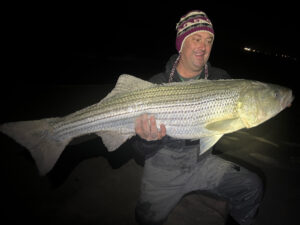
Welaka National Fish Hatchery near St. Augustine, Florida has been stocking striped bass into the St. Johns River since 1970. It provides an exciting fishery that would not otherwise exist on the southern end of the species’ range.
According to Tony Brady, the hatchery’s acting project leader, striped bass once naturally inhabited the St. Johns, which meets the Atlantic Ocean through Jacksonville, Florida’s Mayport Inlet. With regular spawns supporting the population, the Northeast Florida striper fishery thrived.
Now hold that thought for a moment and consider the St. Johns profile.
Stretching 310 miles from its marshy headwaters in lower Indian River County to its Atlantic exit, Florida’s longest and only northward-flowing river receives its inflow mostly from stormwater and natural springs. This yields a low flow rate of 0.3 mph and qualifies the St. Johns as a “lazy” river.
Do Striped Bass Still Spawn in the St. Johns River?
It’s Hard to definitively say whether or not any stripers attempt to spawn in the St. Johns anymore, but as Brady points out, the river no longer provides a favorable scenario.
“We’ve always had stripers in the St. Johns, but at some point the spawning became ineffective to maintain their population in the river,” Brady says. “Stripers are pelagic spawners, which means they release their eggs into the water column. They’re not making a bed like a largemouth or a bluegill.
“Striped bass need to have their eggs floating for 48 hours until they hatch. By remaining buoyant and moving by the river, that prevents them from settling out and suffocating in the river bottom.”
Stocking Striped Bass in Florida
A slow, north-flowing river that pushes against daily tidal influence simply cannot give striped bass what they need. But the challenge runs deeper.
One of the largest challenges came with construction of Rodman Reservoir, a project that dammed what was once the prominent striped bass spawning area. Created in 1968 as part of the former Cross Florida Barge Canal plan, Rodman’s impoundment cut off the Ocklawaha River’s natural flow into the St. Johns.
Addressing this and other species-related challenges, the Atlantic Striped Bass Conservation Act (originated in 1984) laid the groundwork for saving a collapsing fishery. Today, the Atlantic States Marine Fisheries Commission, the National Marine Fisheries Service and the US Fish and Wildlife Service share this management responsibility.
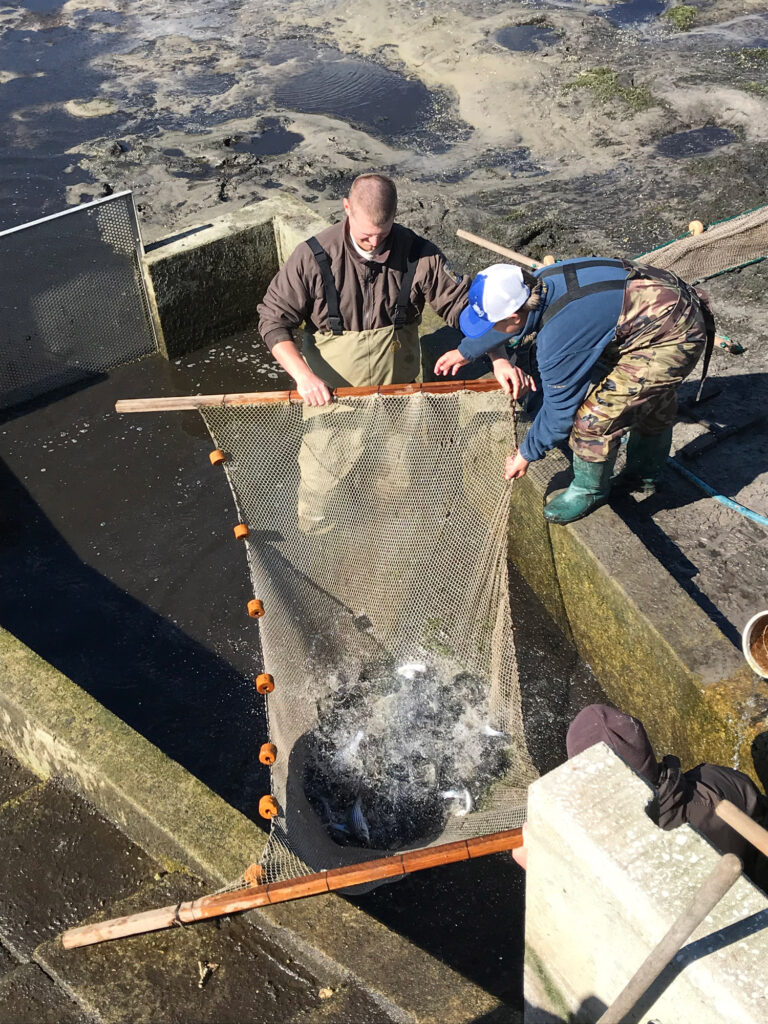
For several decades, the Welaka National Fish Hatchery has stocked inch-long phase 1 fingerlings and 6- to 8-inch phase 2 juveniles into the St. Johns. Brady said the goal is approximately 400,000 fingerlings per year, with releases starting in Welaka, continuing to Palatka, Green Cove Springs, and into the Jacksonville area.
“The Hatchery works with South Carolina Department of Natural Resources because they have a hatchery set up for spawning striped bass,” Brady says. “Where they’re situated, they can get all the brood stock they need, and these are pure Atlantic-run striped bass.
“On a yearly basis, they provide us with (approximately) 1.2 million fry. We put them in our ponds with food sources and let them grow for upwards of 30 days. We then harvest our ponds and stock them into the St. Johns River.”
With the St. Johns habitat dynamics unlikely to dramatically change in the foreseeable future, Brady termed the striped bass stocking as a mitigation project. Thankfully, the effort has paid off with a dependable fishery well worth exploring.
Fishing for Jacksonville Striped Bass
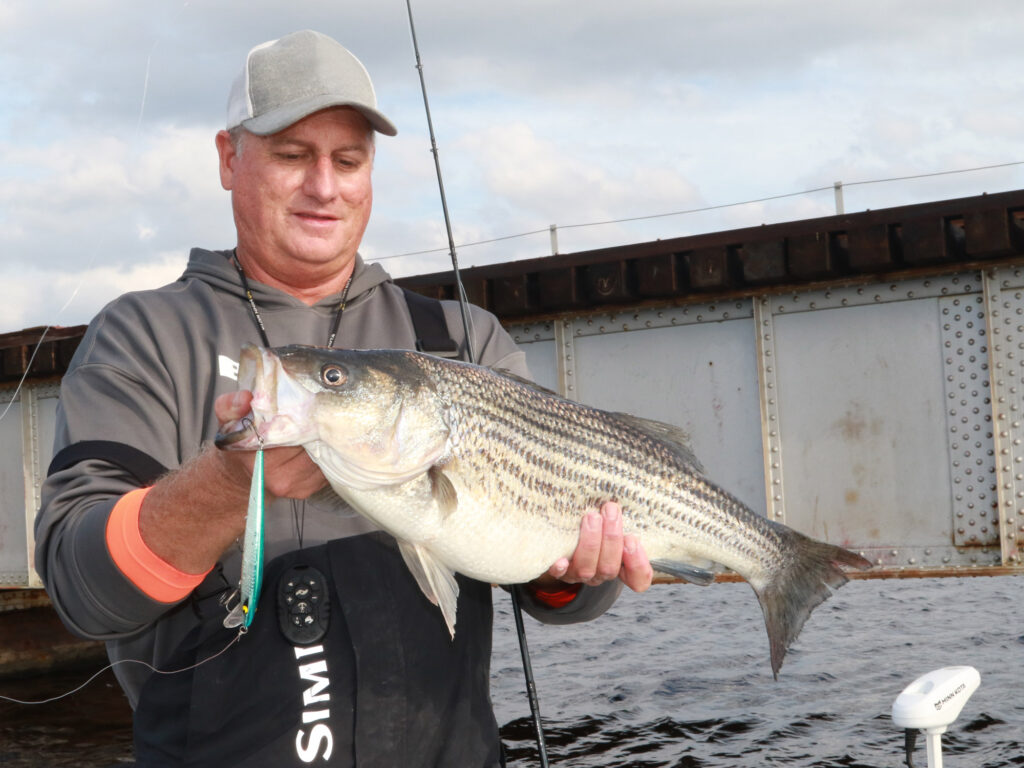
Based in Jacksonville, Capt. Chris Holleman has long enjoyed Northeast Florida’s striped bass fishery. With dependable spots ranging from the St. Mary’s River at the Georgia Border to the Astor area, near the St. Johns’ upper (southern) end, Holleman offers a handful of pointers:
When do Jacksonville stripers bite best?
Obviously striped bass feed throughout the year, but cooler weather cracks the whip on these Florida fish. For Holleman, the first cold front that pushes air temperatures into the 50s tells him it’s time to start focusing on stripers.
“I would say from November through February are the best months,” Holleman said. “When it first starts to cool off in November, they start feeding and about midway through winter they really fatten up.”
Holleman said cloudy, or overcast days offer the best striper opportunities, but he’s quick to note that you shouldn’t rule out a bluebird day. Case in point, while cast netting finger mullet in a Nassau River creek, he found striped bass waking in about a foot of water, as they chased down river shrimp—all under bright, clear skies. Clarity’s important, so the less rain his area receives, the more Holleman expects to find stripers pushing into the inner creeks where they enjoy a mix of finger mullet, shrimp and juvenile menhaden.

Where to fish for Jacksonville striped bass
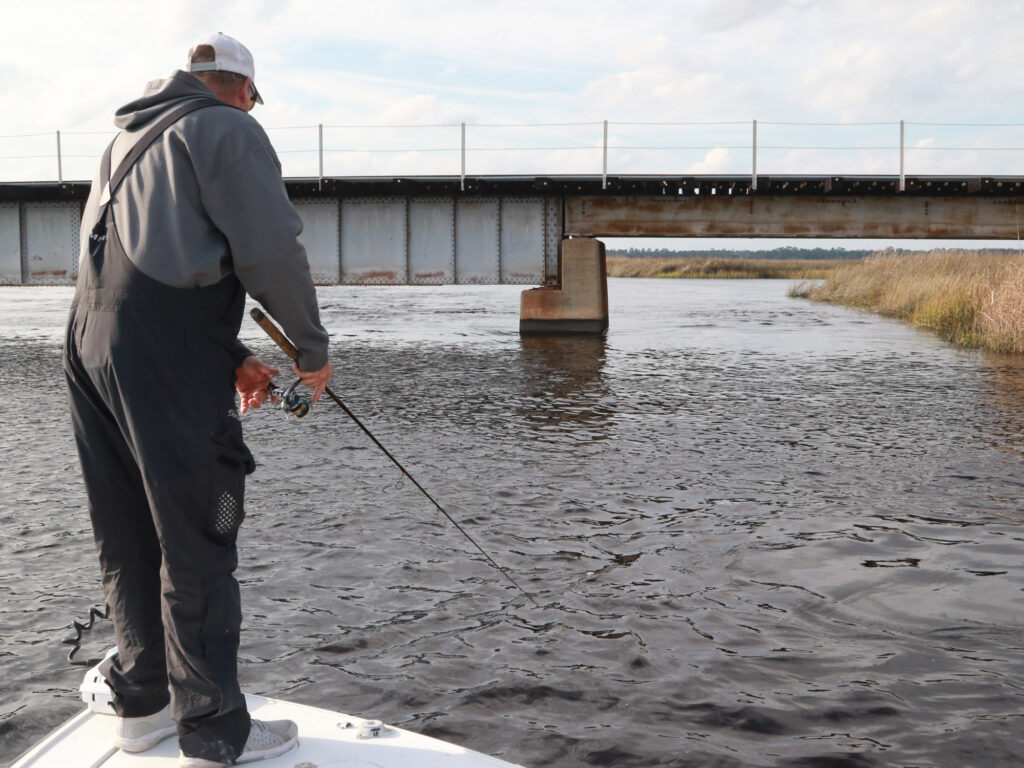
Striped bass are aggressive feeders that like to use natural dynamics to facilitate their pursuits. That’s why Holleman spends a lot of time around railroad trestles, small bridges and anything that provides the current breaks and eddies that help deliver the food.
“On the St. Mary’s River, we catch them a lot in front of creek mouths,” Holleman said. “Some of the creek mouths are outgoing-tide spots and some of them have stripers there on the incoming tide.
“Maybe there’s a ditch along one shoreline, and when that water comes in, it’s a little deeper. Maybe the fish are waiting there to intercept bait.”
In Holleman’s experience, faster moving water seems to be a major criteria for striped bass preference. Find a shoreline with rocks and swift current and that’s money.
“One of the biggest ones I caught—about 25 1/2 pounds—was on a rock pile with an eddy,” Holleman says. “It was an outgoing tide and a cold day.
“Those cold, overcast days seem to be when they’ll move up shallow. They’ll almost telegraph themselves, kinda like tarpon. They’ll actually roll, and you might see a tail sticking out of the water.”
Best Lures for Jacksonville Stripers
While anglers can catch these Northeast Florida striped bass on live finger mullet or menhaden under a noisy popping cork, or a slip float for deeper spots, Holleman prefers artificial lures for their strategic targeting ability.
High on his list are jerkbaits like the Smithwick Rogue Perfect 10, a Cotton Cordell Redfin, and a Booyah Flashpoint. He’ll also throw a lipless bait like a Cotton Cordell Hotspot, but with all of his choices, getting down into the current is the key to engaging stripers.
“A lot of these places like the railroad trestles and small bridges are limited casting spots, so I’ll cast past the spot and let the current bring the bait past the spot,” Holleman said. “Then I’ll bring it down into the strike zone and use a twitch-twitch-pause until they get it.”
Holleman’s also fond of vertically working a YUM Pulse on a 1/2- to 1-ounce jighead next to structure, especially on bright days, which tend to send the fish deeper. That being said, he keeps an open mind when it comes to fish positioning. Like all savvy predators, stripers will position near the food.
“I think the biggest thing people don’t understand about stripers is that they’re not always on the bottom,” Holleman said. “They may be in 30 feet of water, but they’re 4 feet down.”