line test photo
“When are you guys going to do another line test?”
That seems to be one of the questions asked of SF editors most consistently. So I decided recently that I couldn’t put off the task any longer.
Here, you’ll see the results of tests and specific information gathered for each line — some of which are likely to prove a surprise — to help you optimize the dollars you spend buying line, which is often no small investment (see chart showing cost per yard).
**
Testing Methods**
I wanted to offer a comparison of many different lines of the same strength — at least according to their labels. I chose 20-pound lines as an intermediate strength with wide applicability. While there’s no suggestion that these results will necessarily prove applicable for other strengths of the same lines, they should allow some insight into how the brands might compare.
I tested many of the more popular monofilaments and fluorocarbons (some sold as main line, others as leader) and braided lines — 76 in all.
Break tests were conducted using the sophisticated Instron tensile tester at the International Game Fish Association headquarters in Dania Beach, Florida. This is, of course, the same sophisticated, computerized testing machine the IGFA uses to test all lines submitted with world-record applications; it is checked and calibrated regularly.
I tested both line strength and knot strength.
To test the tensile (straight line) strength, I performed five break tests, discarding the highest and lowest results, and averaging the three remaining. I also recorded the standard deviation.
To test knot strength, I used a “real-world” knot, one which I believe is the best way to connect anything to any main line or leader — that is, using a double line formed by a Bimini twist. I tied 12-turn Biminis exactly the same way, finishing each with a simple triple-half-hitch lock.
I performed break tests on three such knots for each line, averaging the three, and again noting standard deviation.
All lines were tested dry, rather than soaking them (regarding the implications of this for monofilaments, see the discussion of results for absolute break strength).
I measured line diameter with a digital caliper (and compared my results with diameters claimed by manufacturers). With hard, round monos and fluoros, this is a no-brainer. Braids are somewhat notorious for being difficult to caliper, because they’re not solid and want to compress when the jaws of a caliper apply pressure to get a reading. Using the least amount of pressure necessary to get a result, I averaged several readings taken from different spots along a length of the line.
Finally, you’ll see the cost per yard listed for each line. These might not represent manufacturer’s suggested retail pricing, since I chose to look for a price (for 300 to 600 or so yards where available) online from one of several large online retailers.** **
Qualities Not Tested
It’s worth noting those characteristics of fishing lines that were not tested here. This includes abrasion, a quality I would dearly love to test were a truly effective method of testing for abrasion available. Unfortunately, abrasion testing is more involved than testing tensile break strength, and we have yet to find a suitable testing machine for that purpose.
Although the Instron does measure stretch, in this series of tests, I did not include stretch for each line. Typically, monofilaments will stretch 10 percent to 20 percent or more; braids should stretch less than 3 percent.
These results do not measure castability, memory or other characteristics important to anglers. In many cases, actually using a line will prove the only way to truly assess all of its qualities.
QUICK LINKS:
Actual Diameters | Strength to Diameter Ratio | Actual Break Strength | Knot Strength | Cost Per Yard
**
**
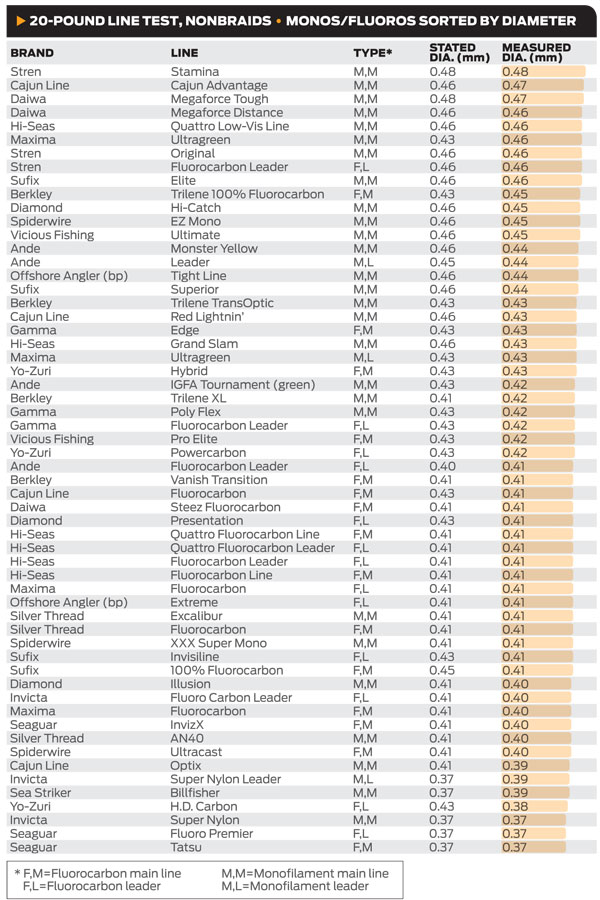
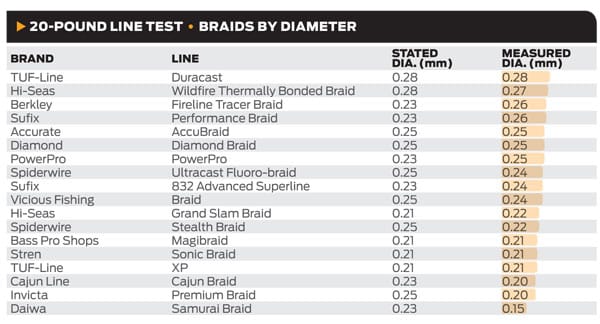
Diameter
In most cases, manufacturers’ stated diameter for monos/fluoros varied marginally, if at all, from what my electronic calipers measured. And, somewhat surprisingly, where discrepant, the measured sample often proved smaller than the spool’s stated diameter.
For braided lines also, the difference between stated and measured diameter differed less than I would have expected, especially considering that braids can be trickier to measure. In a few cases, diameter measured much less than stated.
In many respects, the thinner a line for a given strength, the better. Smaller lines allow more capacity on the spool, are likely to cast farther and easier, and offer less water resistance. On the other hand, thinner lines generally offer less abrasion resistance, since any scrape or nick takes out a larger proportional chunk of them.
Also, this chart indicates whether each line is a monofilament or a fluorocarbon, and whether it’s sold as a main line or (in spools with less line) as leader.
** ****Actual Diameter | Strength to Diameter Ratio | Actual Break Strength | Knot Strength | Cost Per Yard**
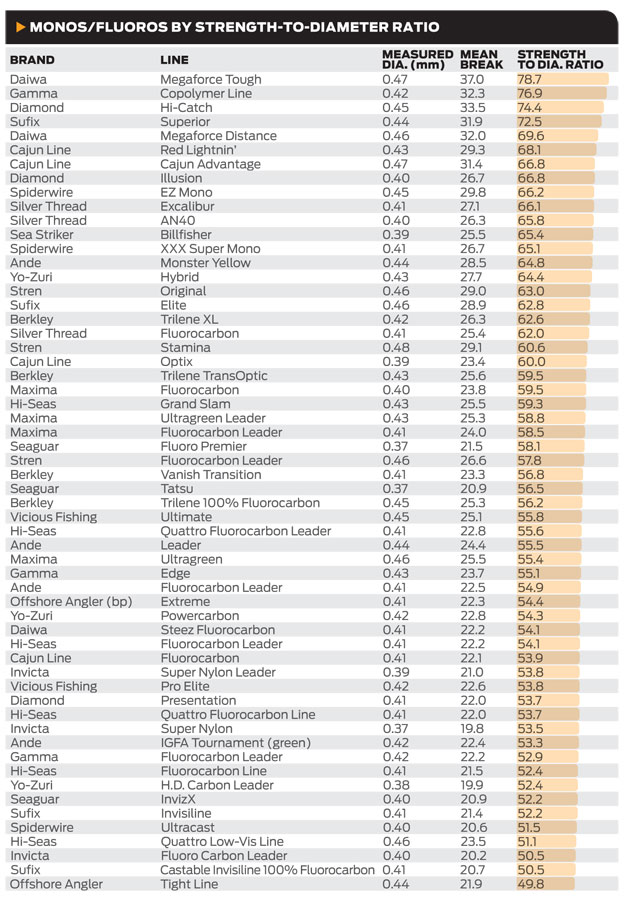
Strength Relative to Diameter
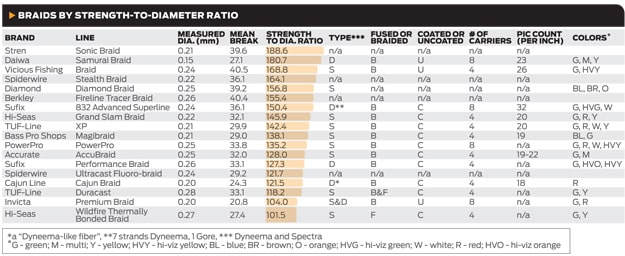
These calculations show the true strength of each line as a simple function of its (measured) diameter. This allows you to consider both a line’s diameter and its strength. The ratio really reflects how “strong” a line actually is. The differences among braided lines are more extreme than among monofilaments. I have also included in this chart several characteristics of braided lines, including the type (Dyneema or Spectra). Fused or braided refers to how the filaments are joined; fused lines do not truly fuse all filaments. Many lines are coated; the manufacturers, at least, maintain that coating enhances castability, and they certainly allow for the addition of color — but most coatings wear or fade in time.
** ****Actual Diameters | Strength to Relative Diameter | Actual Break Strength | Knot Strength | Cost Per Yard**
Actual Break Strength
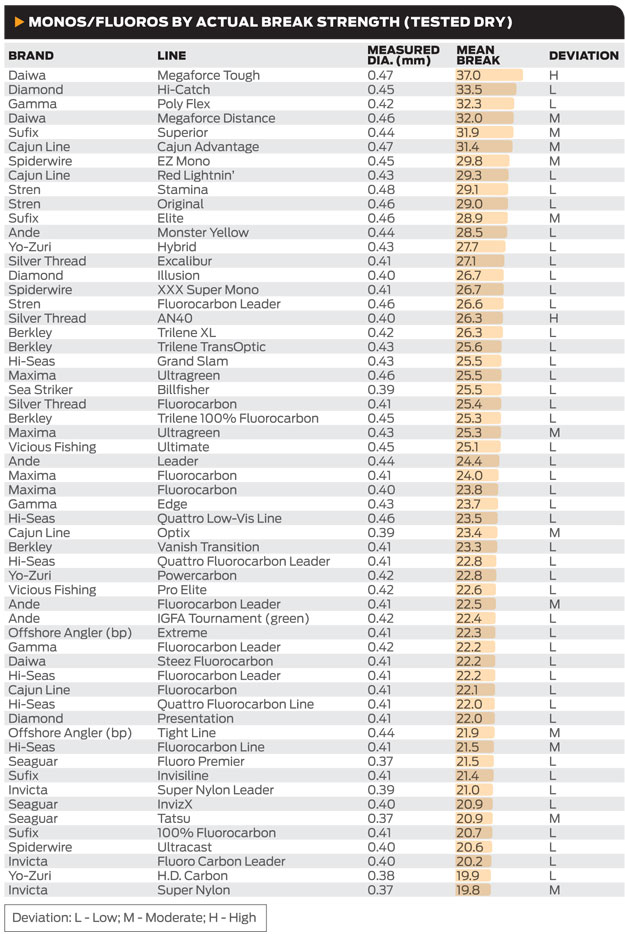
This shows at what point the lines broke, regardless of their diameter. These “20-pound” monos/fluoros actually range from 19.8 pounds to 37 pounds. The IGFA specifies line class by kilograms, so 20-pound-line-class records are allowed to break up to 22.2 pounds; that’s the number when converting 20 pounds to kilograms. That means for the purposes of records, tournaments or simply those who fish by line classes, 18 of 58 lines tested as truly 20pound class.
However, the odds are good that several more mono lines in this test would also be in the 20-pound class, because all lines were tested dry. For braids and fluorocarbons — which do not lose strength when wet — that has no effect on breaking strength. Monofilaments, on the other hand, do lose some strength when wet; the amount varies and might range from just 2 percent or 3 percent to 10 percent or so. (The IGFA tests monos after soaking them.)
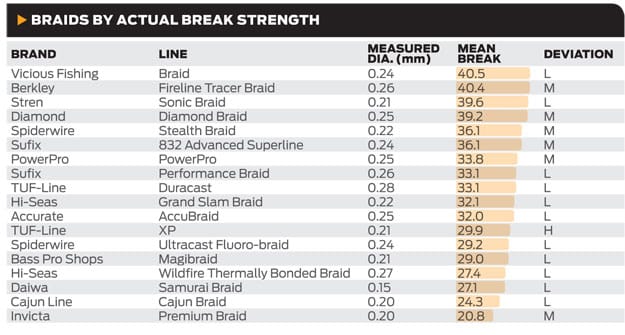
The braided lines ranged from a high of 40.5 pounds to a low of 20.8. As expected, most broke considerably higher than monofilaments. So for the 18 braids tested, all but one exceeds the 20pound class, four by roughly twice as much as the strength stated on the spool. Manufacturers traditionally justified what might be considered misleading labeling by pointing out that braid’s knot strength for most consumers would be in the 70 percent to 80 percent range. However, braided lines have improved their knot strength in the years since those claims were made, and as these tests show, a well-tied Bimini will provide 90 percent to 100 percent strength in most cases.
Deviation — listed very generally as low, moderate or high — proved low for most lines, suggesting a high level of consistency.
** ****Actual Diameters | Strength to Diameter Ratio | Actual Break Strength | Knot Strength | Cost Per Yard**
Knot Strength
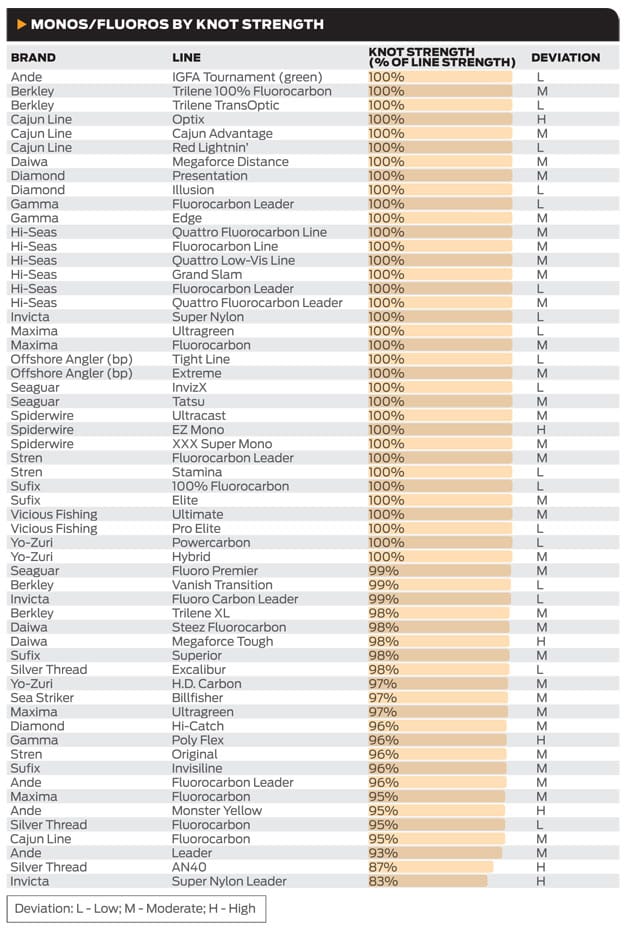
If line manufacturers brag of great knot strength, it might be more than just hype. A rather remarkable 35 of 58 monofilaments and fluorocarbons tested with a straightforward 12turn Bimini offered 100 percent strength. Eight more offered virtually full strength at 98 percent or 99 percent. And all but two of 58 tested at more than 90 percent.
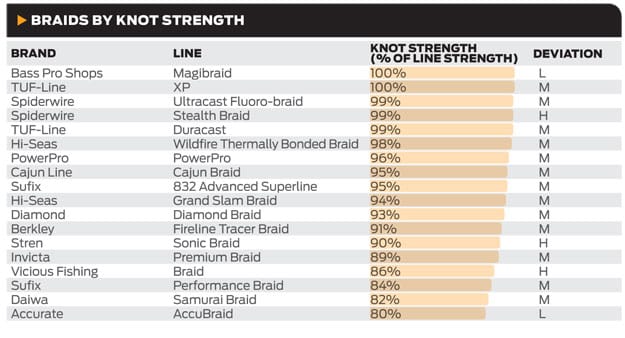
A greater range of knot strengths was evident with braided lines, from 100 percent to 80 percent. The Bimini knots in 33 percent of the braids tested (six of 18) broke from 98 percent to 100 percent, a pretty respectable proportion. And 13 of 18 broke at 90 percent or higher.
** ****Actual Diameters | Strength to Diameter Ratio | Actual Break Strength | Knot Strength | Cost Per Yard**
Cost Per Yard
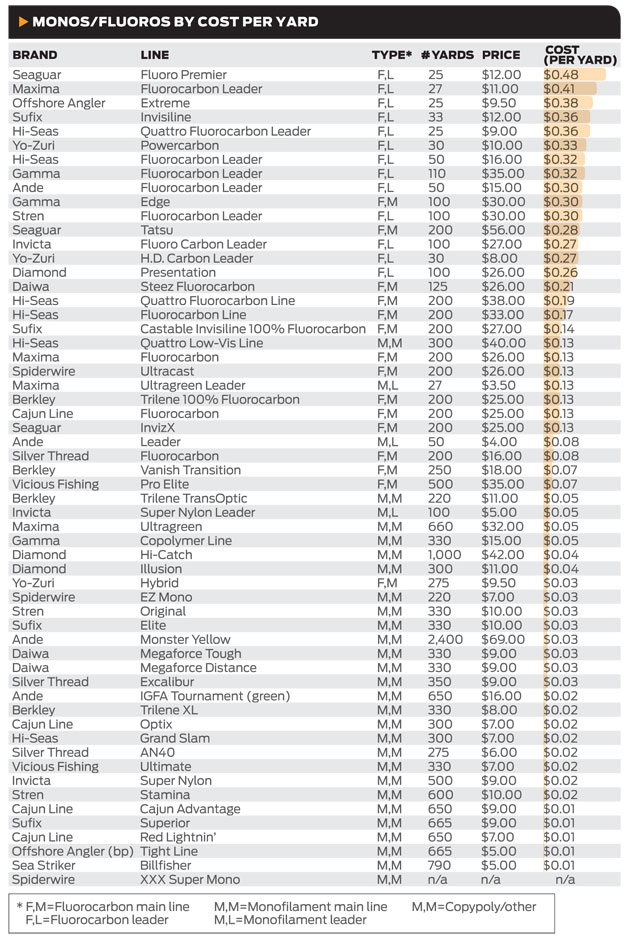
The greatest variation for the 76 lines came in the category of cost. As you might expect, you’ll pay the most for fluorocarbon leader and then for fluoro main lines. Most of the latter run from 7 or 8 cents per yard to more than 30 cents (though I found Yo-Zuri Hybrid for 3 cents per yard).
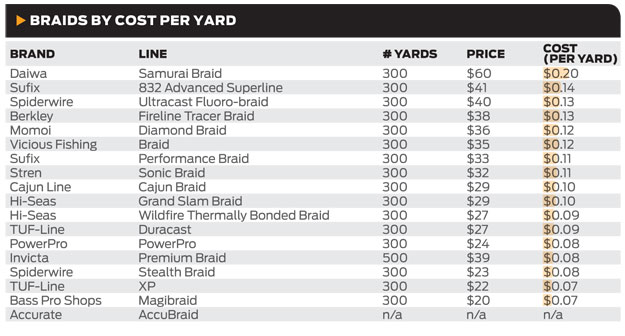
Braids usually run a good bit more than monofilaments; I found most monos available from 5 cents to less than 1 cent per yard.
The most expensive leader was Seaguar Fluoro Premier, at 48 cents per yard. The priciest monofilament main line was Hi-Seas Quattro, at 13 cents per yard. Among braided lines, Daiwa’s Samurai Braid came in as most expensive, at 20 cents per yard. On the bargain side, five monofilaments came in at a penny per yard (in fact, a bit less since the chart rounds up to 1 cent) and, among braids, Bass Pro’s Magibraid was least costly at 7 cents per yard.
** ****Actual Diameters | Strength to Diameter Ratio | Actual Break Strength | Knot Strength | Cost Per Yard
**