Peek inside the tackle box of a serious angler, and you’ll find a wide variety of hooks in all shapes and sizes. Circle hooks, J hooks, treble hooks, live bait hooks, O’Shaughnessy hooks, assist hooks, hooks for soft plastics — the list goes on and on. But have you ever wondered what goes into making these little pieces of metal? Have you ever considered a hook’s composition and construction?
Over the years, manufacturers have honed the art of hook making into a real science. And that’s a good thing, because the hook is arguably fishing’s most important piece of terminal tackle.
Stainless-Steel Fishing Hooks: Rust Resistant
All manufacturers develop and protect their own special “recipes” when it comes to hook construction, but there are really only two types of metal wire used these days: stainless steel and high‑carbon steel.
Stainless-steel hooks have been around forever. While not as strong as carbon steel, stainless holds a key advantage for saltwater anglers — it’s much more corrosion resistant.
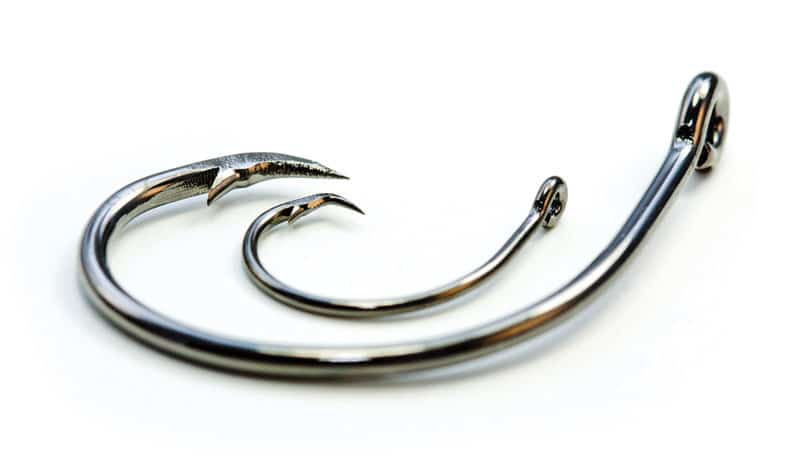
Nickel is the key ingredient that wards off rust. The more nickel in a stainless blend, the less corrosion. Of course, higher nickel content also leads to brittleness, which is not a good thing in hooks.
Four varieties of stainless steel are commonly used in manufacturing, says Jeff Pierce, sales manager at O. Mustad & Son Inc., and each possesses its own unique set of qualities. Mustad uses Martensitic stainless steel. It contains an ideal nickel composition; Martensitic is not the most corrosion-resistant variety of stainless, but it is harder and stronger than many others.
Stainless-steel hooks have other advantages too, according to Matt Gray, marketing manager at Wright & McGill, which owns the Eagle Claw hook brand. “They generally have a sharper point right out of the package,” he says.
Still, a stainless-steel hook has an inherent problem as it relates to recreational fishing: Because it doesn’t rust quickly, it’s not always good for the fish.
“If you break one off and the hook is deep, it won’t rust out and the fish could die,” explains Tony Shitanishi, national sales manager at Owner American Corp.
High-Carbon Steel Fishing Hooks: Thin, Yet Strong
And that’s one of several reasons that many manufacturers have gotten away from producing stainless-steel hooks. In fact, it’s illegal to use stainless hooks in some fisheries these days.
Enter carbon-steel hooks. The wire bodies on this type of hook contain carbon — and while these hooks will rust, the higher the carbon content, the harder the metal alloy becomes. “If you have two hooks of the same diameter,” explains Pierce, “the carbon-steel hook will be stronger than the stainless-steel hook. It’s more likely to bend under heavy strain, while a stainless-steel hook might break.”
Because carbon steel is a stronger base material than stainless, the wire is proportionally thinner — and that can be a real plus when it comes to hooking fish.
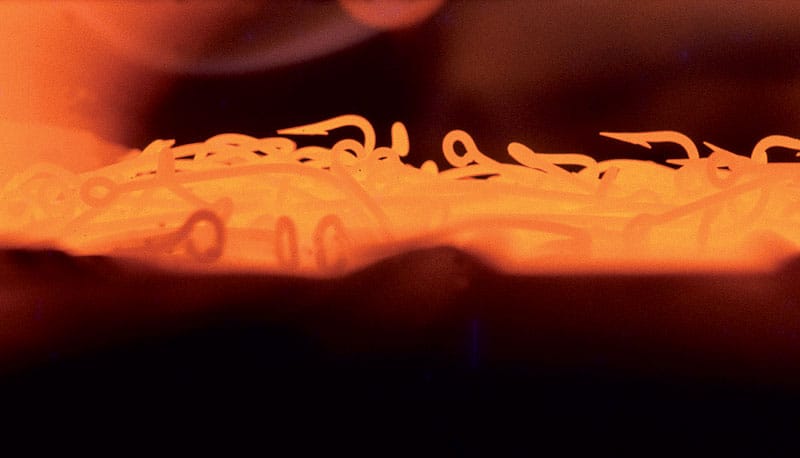
“If you don’t think a thinner diameter is important, ask your nurse for a bigger needle the next time you get a shot,” jokes T.J. Stallings, director of marketing at TTI-Blakemore Fishing Group, which owns the Daiichi hook brand.
The process of making a carbon-steel hook is not overly complicated, and these hooks are actually much less expensive than stainless. Straight lengths of wire are cut into pieces, and a point is honed on one end and an eye formed on the other. The wire is then bent around a cam, forming the hook’s ultimate shape.
“The wire is really soft at this time,” says Shitanishi. “You can usually bend it with your hand.”
To strengthen the metal, hook makers often cold-forge or compress saltwater hooks. And then they’re tempered, or heat-treated. This is the most crucial stage of hook making. The tempering molecularly alters the metal, concentrating the carbon and removing impurities.
“Depending on the hook size, type and wire gauge, there’s usually an optimum temperature,” says Shitanishi. “It’s something of an art.”
The hooks are then carefully cooled and intermittently dipped in oil. Then, once cool, the carbon-steel hook is ready to be plated.
Fishing Hook Finishes and Coatings
An art form too, this plating process also marks a key point of differentiation from stainless-steel hooks. While stainless hooks require no protection from corrosive salt water, vulnerable carbon steel must be coated.
These coatings vary from bronze varieties — which offer little corrosion resistance — to concoctions that contain more protective elements like nickel, zinc and tin. Most manufacturers offer proprietary finishes, such as Eagle Claw’s new Platinum+ coating, which are designed specifically for the rigors of salt water.
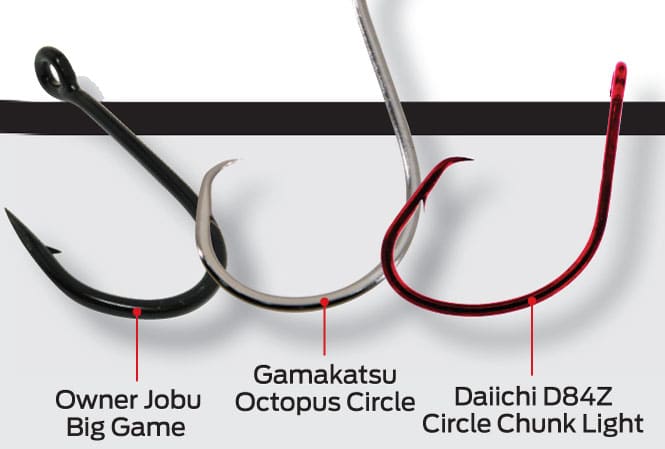
“We’re using a lot of black-nickel finish,” says Syd Rives, national sales manager for Spro Corp., which distributes Gamakatsu hooks. “We probably sell five black hooks for every one with a tin finish. It just looks tough. A lot of people think a black hook is stronger than a different-color hook, but it’s not. It’s often the same hook.”
A coating’s appearance can no doubt be a selling factor. But it has other roles too, including serving as a component in an angler’s presentation.
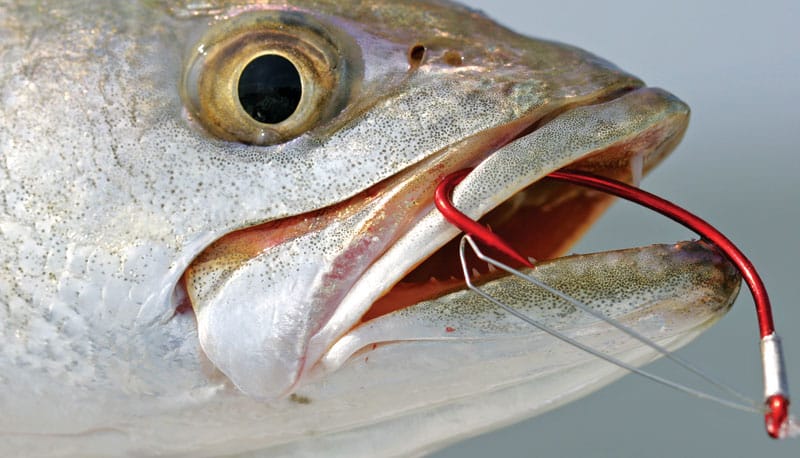
“Take a look at red hooks,” says Stallings. “We launched them in 2000 and still offer the color in pretty much all of our hook styles. The blood/injury factor really can make a huge difference in fish striking.”
But even with the best finish, it’s important that anglers take care of their carbon-steel hooks. This is especially true when sharpening a hook point, as doing so removes the protective coating, leaving the exposed metal vulnerable to corrosion. But it’s not the only time.
“You’ll watch a guy put all his hooks from the packaging into a tackle box, and then salt spray will come over the rail and cover 400 hooks in his box,” says Pierce. “Inevitably, these hooks will rust. That can get really expensive.”
Pierce keeps his hooks in their original packaging and then stores them in plastic bags in binders commonly used for plastic worms in freshwater bass fishing. “They’ll never get wet and stay completely protected,” he says.
A little care can go a long way — so keep your hooks primed and ready for action.