I remember as a youngster skimming across a large flat one morning in the northern Bahamas looking for bonefish. On plane, my boat could fly in only about 8 inches of water. I pulled back the throttle and stopped in a hole so as not to hit bottom with my engine. But the tide was ebbing quickly, and the flat was large enough that I couldn’t pole off before it went dry. I sat there awaiting the next tide for a very long time rather than dig up the bottom to make my escape.
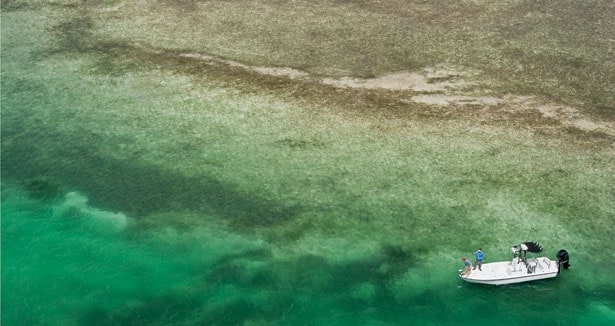
Fly over any location in the Florida Keys just once and you’ll see scars left by boat propellers along the fragile bottom. Yes, many flats and bay skiff operators get pretty cocky about how shallow they can run. I cringe each time I see a recreational boater drop anchor on top of a patch reef. And then there are the flats-skiff owners who think that just pushing the throttle forward and trimming up prevents them from destroying turtle grass. How can you avoid adding to this problem? Consider one or more of the four P’s.
Power
Obviously, the higher on the transom you can run the engine, the farther away from the bottom the propeller will rise. Taken to its extreme, that means mounting an outboard on an adjustable jack plate, pushing a low-deadrise, tunnel-hull boat with trim tabs.
Though more horsepower might get you on plane quicker, the added weight of a heavier engine can also drag the stern down. And when poling your way off a flat, that same weight can be a strain.
Remember too that trolling motors use propellers that can dig up the earth beneath your hull. Always be sure to raise the shaft of your trolling motor so the lower unit travels well above the bottom and any vegetation.
Finally, it’s probably not just the bottom you destroy when you see all that mud behind your boat. The engine’s cooling system sucks in that mud, sand, grit and those shell bits, all of which can absolutely damage that expensive bit of iron hanging on the transom.
Planing
The two most potentially bottom-damaging scenarios for a shallow-water skiff are running at speed across a flat and getting up on plane from a dead stop in shallow water. As you advance the throttle from a stop, the bow rises and the stern squats, lowering the spinning prop toward the bottom. When you see the cloud of mud/sand/grass billow behind your boat as you do this, you’ve already done damage.
The best solution is to pole your way off the flat into deeper water, where you can throttle up with impunity or try one of two other methods. In one method, angle your trim tabs and engine all the way down. If you have a jack plate, raise it. You might even have your passenger(s) move to the bow to keep the stern higher in the water. Then push the throttle forward. Your boat should suffer little or no bow rise using this method.
The other method is called spinning up. Turn your steering wheel hard over (usually to port is the more effective side, because it utilizes the propeller’s natural torque to help turn). Push the throttle forward. The propeller pushes the stern up and away from the bottom when turned like this. As you build up speed, you can then straighten out, and you’ll be on plane. Usually about 180 degrees is sufficiently far to turn, and by all means, always warn your passengers prior to any radical maneuver like this! They’ll want to hold on tightly.
Planning
My early episode with waning tides taught me to plan ahead. Be aware of what the tide is doing while you’re out there. Don’t head onto a shallow flat when you know the tide is likely to strand you.
When negotiating the shallows, know your various escape routes — especially those downwind and down-current. Be aware of moon phases and their effects on the flats. What you might be able to float over today might be considerably shallower in a week or two.
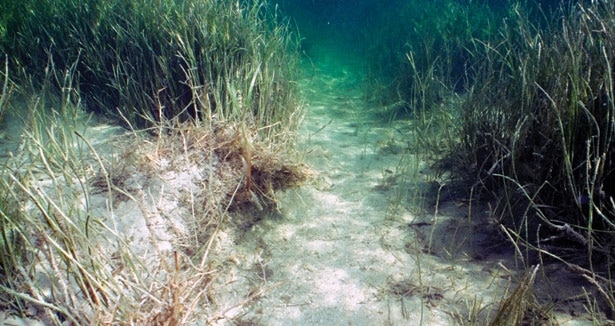
Learn to read the various bottoms. Know the difference between grass, sand and solid. Learn how to accurately read the depth at a glance, remembering that in clear, shallow water, the appearance of depth can be very deceptive. Darker water often means deeper water. If you see a bird standing on a flat, chances are good you shouldn’t go there.
Patience
Though a sage person once said that fishermen and sailors possess more patience than the average person, I know plenty today who have little to none. Our fast-paced society seems populated by more Type A personalities than ever. They always try to take the shortest path between two points —consequences be damned. That kind of philosophy, that “It’s all about me!” attitude, can wreak havoc on fragile shallow environs. So here are a few suggestions that you should actually stop to consider as you run between fishing spots:
- If you want to travel over a flat that might be too shallow to transit without causing damage, go around it instead of across.
- If you get stuck on a flat, pole your way off rather than tilting the engine and digging a trench to deeper water.
- Remember that your boat will float considerably higher without anyone aboard. Sometimes the altruistic way to exit a flat is to get off your boat and push: low-tech, but very effective.